
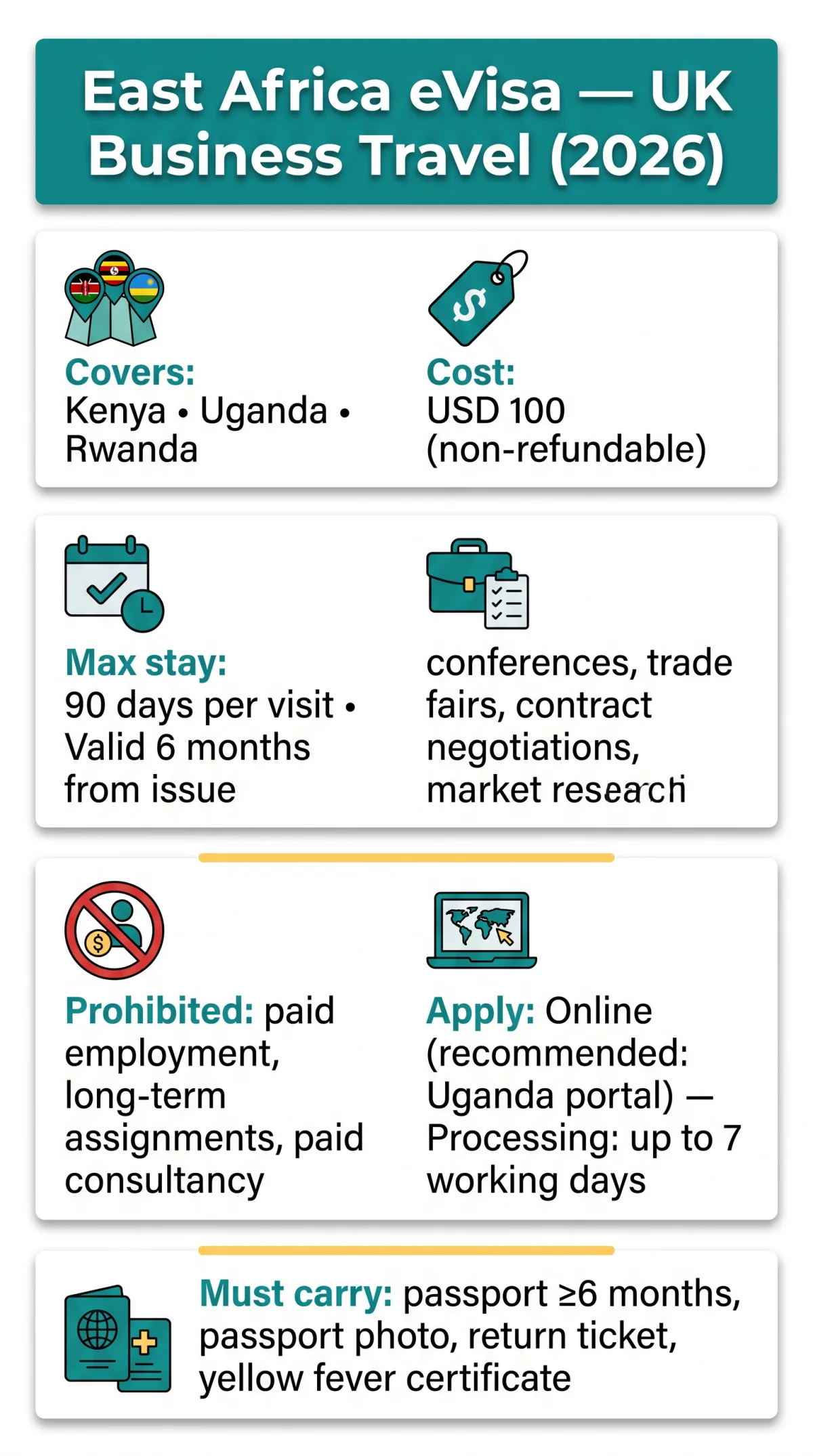
UK citizens can use the East Africa eVisa for UK citizens for UK business travel across Kenya, Uganda, and Rwanda. Permitted activities include attending conferences, trade fairs, contract negotiations, and market research. The visa strictly prohibits paid employment and long-term work assignments. It costs USD 100 and allows a 90-day stay per visit.
Featured Snippet: UK citizens can use the East Africa eVisa for UK business travel in 2026. Permitted activities include attending conferences, trade fairs, contract negotiations, and market research. The visa prohibits paid employment and long-term work assignments. It covers Kenya, Uganda, and Rwanda, costs approximately USD 100, and allows a 90-day stay per visit.
What Is the East Africa Tourist Visa and Can UK Citizens Use It for Business?
The East Africa Tourist Visa (EATV) is a joint multiple-entry digital visa for Kenya, Uganda, and Rwanda, allowing 90 days per visit, valid 6 months from the date of issue, at a cost of USD 100 (non-refundable, plus bank charges), with free intra-zone movement and no extra border fees. UK passport holders qualify for the East Africa Tourist Visa (EATV) entirely online without embassy visits, provided their passport has at least 6 months validity from the date of entry and at least 1 blank page. The issuing country must be the first entry point into the zone. Tanzania is not part of the EATV. Kenya operates a separate Electronic Travel Authorisation (eTA) via etakenya.go.ke with a standard fee of US $30 (expedited: US $100 additional), but EATV holders entering the bloc via the issuing member can circulate into Kenya without a standalone tourist eTA under the trilateral agreement. For a detailed comparison, see our guide on East Africa eVisa vs Kenya eTA.
Permitted and Prohibited Business Activities Under the East Africa Tourist Visa
The statutory basis for the East Africa Tourist Visa (EATV) includes the Uganda Citizenship and Immigration Control Act CAP 313 (as amended by Act 2009) and the Kenya Immigration Act. According to the Uganda Directorate of Citizenship and Immigration Control (DCIC) via immigration.go.ug, the EATV is issued for “tourism purposes only” and “prohibits employment.”
| Allowed ✅ | Prohibited ❌ |
|---|---|
| Conferences, trade fairs, networking events | Paid employment |
| Contract negotiations and signings | Paid consultancy |
| Market research, fact-finding missions | Technical installations |
| Site visits, board meetings | Training others for a fee |
| Exploratory business meetings | Long-term assignments, permanent work contracts |
Decision logic: “Are you being paid locally?” → work permit needed. “Attending a conference or negotiating a contract?” → EATV sufficient. Example: A UK marketing director attending a 3-day conference in Nairobi and signing a distribution agreement with a Kenyan firm – both activities are fully permitted under the East Africa Tourist Visa (EATV). If you are being paid locally, the EATV is insufficient and a country-specific work permit is required.
How UK Citizens Can Apply for the East Africa eVisa and Documents to Carry
UK passport holders apply for the East Africa eVisa fully online; processing takes up to 7 working days, approval sent as PDF via email.

Select the issuing country
Uganda’s portal (visas.immigration.go.ug) is recommended for UK applicants.
Complete the online form
A six-digit application ID is generated automatically as your reference.
Upload required documents
Passport bio-data page (valid ≥6 months), recent passport photo, return ticket or travel itinerary, and yellow fever vaccination certificate.
Pay the fee
USD 100 non-refundable fee (plus bank charges).
Receive the eVisa PDF by email
Print it for border control.
Mandatory documents (✅):
- ✅ Passport bio-data page (valid ≥6 months, machine-readable strip not cropped)
- ✅ Recent digital passport-style photograph (white background, taken within six months)
- ✅ Return ticket or detailed travel itinerary
- ✅ Yellow fever vaccination certificate (required at port of entry regardless of visa status)
Recommended business documents (⚠️):
- ⚠️ Employer support letter (stating purpose, dates, financial guarantee, host contact details)
- ⚠️ Host-company invitation letter from East African partner (confirmed local entity, dates, meeting purpose)
- ⚠️ Company registration certificate or current business card
- ⚠️ Proof of sufficient financial means (bank statements)
- ⚠️ Return flight confirmation and accommodation booking
Note: immigration.go.ug states “Any other documents may be required during processing” – carry these as standard practice.
Rwanda workaround: UK passport holders are visa-exempt for Rwanda for 30 days under Commonwealth arrangements, which blocks online EATV pre-application via the Irembo portal. Solution: purchase the East Africa eVisa on arrival at Kigali Airport (USD 100) or apply via Uganda’s portal and enter through Entebbe. Check the FCDO travel advice before departure to ensure compliance with current entry rules.
Costs, Processing Time, and Payment Details for the East Africa Tourist Visa
EATV fee: USD 100 non-refundable, plus bank charges. Processing: up to 7 working days. Max stay: 90 days per visit within 6-month validity. Multiple entries permitted within the zone with no extra border fees. A new EATV application (USD 100) is required after every exit from the Kenya-Uganda-Rwanda zone; the visa is non-renewable and non-extendable in-country.
| Feature | EATV | Individual Country Visas |
|---|---|---|
| Cost | USD 100 total | Upwards of USD 150 combined (~$50 each × 3) |
| Entry type | Multiple-entry | Single-entry each |
| Countries | Kenya, Uganda, Rwanda | One per visa |
| Return visit | Covered within validity | Must pay fee again |
Kenya introduced mandatory travel health insurance effective August 2026, requiring minimum US $50,000 cumulative coverage for all non-Kenyan visitors staying under 12 months. Existing UK policies meeting this threshold are accepted. Proof expected as part of Kenya eTA application.
When You Need More Than the East Africa Tourist Visa: Work Permits and Alternatives
UK travellers requiring paid work in East Africa need country-specific permits – the East Africa Tourist Visa (EATV) does not authorise any remunerated employment.
- Uganda: Special Pass (Class G), Corporate Visa – issued by NCIC Uganda (Plot 65/67, Old Port Bell Road, Kampala, Uganda; +256 417 102 600). Statutory framework: Uganda Citizenship and Immigration Control Act CAP 313, as amended by Act 2009.
- Kenya: Temporary Work Permit, Class M work permit – issued by Kenya Department of Immigration.
- Rwanda: Class C Work Permit – issued by Rwanda Directorate General of Immigration and Emigration.
In-country conversion from an EATV to a work permit is generally not possible – exit and re-entry on the correct permit category is required. For UK expatriates or intra-corporate transferees beyond 90 days, corporate visa pathways exist per country. Consult the official immigration portals of Uganda, Kenya, or Rwanda for current work permit requirements.
FAQ: East Africa eVisa for UK Business Travel
Can I attend a business conference in Nairobi if my EATV was issued by Uganda?
Yes. EATV allows free circulation; carry printed eVisa and passport; officers may request conference venue address.
Does the East Africa eVisa allow me to sign a contract with a Kenyan company?
Yes, contract signing and negotiations are permitted. Paid execution of the contract requires a work permit.
Do UK business travellers need travel insurance for an EATV trip?
Kenya requires minimum US $50,000 health coverage from August 2026. Uganda and Rwanda recommend but do not mandate travel insurance. Check if your UK policy meets the threshold.
What happens if my EATV expires while I am still in East Africa?
Non-renewable; expires on exit; re-entry requires new application and USD 100 fee. Overstaying incurs penalties.
Is the EATV the same as the Kenya eTA?
No. Kenya eTA is a separate single-country authorisation ($30 standard, $100 expedited). EATV holders entering via the issuing member can circulate into Kenya without a separate tourist eTA.
Can I do paid freelance work on the East Africa Tourist Visa?
No. Any remunerated activity requires a specific work permit. The EATV strictly prohibits employment.
What if I need to bring professional equipment (cameras, demo units) into East Africa?
UK business delegates carrying broadcast, engineering, or demo equipment should use an ATA Carnet via the London Chamber of Commerce for temporary import across EAC borders. Custom bonds and temporary import clearance procedures apply.
How long does the EATV application take for UK passport holders?
Standard processing: up to 7 working days. Apply at least 3 weeks before travel. Express processing may be available for an additional fee.
Do I need to carry my printed eVisa at border control?
Yes. The approval letter is emailed as a PDF. Print a copy and carry it alongside your passport at all entry points.
Can UK citizens enter the East Africa Tourist Visa zone through Rwanda?
UK passport holders are visa-exempt for Rwanda for 30 days, which blocks online EATV pre-application via Irembo. Purchase EATV on arrival at Kigali Airport (USD 100) or apply via Uganda’s portal and enter through Entebbe.
Last updated: September 2026. Sources: Uganda Directorate of Citizenship and Immigration Control (immigration.go.ug), Kenya eTA portal (etakenya.go.ke), UK FCDO travel advice. Disclaimer: This article is for informational purposes only and does not constitute legal or immigration advice. Always consult the FCDO travel advice and the relevant embassy or immigration authority for the most current rules.