
Published: 15 January 2026. Last updated: 1 August 2026 (added Kenya mandatory health insurance rule). This guide is verified against official government portals quarterly; last verified 20 July 2026.
The East Africa Tourist Visa (EATV) is a single USD 100 electronic visa granting UK travellers 90-day multiple-entry access to Kenya, Uganda, and Rwanda. British citizens apply online through any of the three countries’ immigration portals, submitting a passport scan, photo, itinerary, and yellow fever certificate. The visa permits tourism purposes only, is non-extendable, and exiting to a non-member country such as Tanzania immediately and irreversibly cancels it. Apply 2 to 4 weeks before departure; the 90-day validity window starts at issuance, not arrival. The issuing country must be your first point of entry into the region, and biometric capture is required at a designated border crossing after approval.
What Is the East Africa Tourist Visa (EATV)?
The East Africa Tourist Visa is a joint USD 100 tourist-only visa covering Kenya, Uganda, and Rwanda – but not Tanzania. It grants 90-day multiple-entry access across all three countries under a single electronic permit, replacing the need to obtain separate visas at each border.
The East Africa Tourist Visa (EATV) is issued for tourism purposes only; employment of any kind is prohibited. It covers Kenya, Uganda, and Rwanda exclusively – Tanzania is explicitly excluded from the scheme and requires its own separate e-Visa. Travellers crossing into Tanzania or any other non-member country will have their East Africa Tourist Visa immediately and irreversibly cancelled.
The flat USD 100 fee makes the East Africa Tourist Visa more cost-effective than purchasing three single-country visas at USD 50 each, provided the itinerary includes at least two of the covered nations.
Who Is Eligible for the eVisa East Africa from the UK?
The East Africa Tourist Visa (EATV) is open to UK passport holders and most nationalities residing in the UK. It permits tourism, family visits, and transit only – employment is strictly prohibited.
UK passport holders are fully eligible for the EATV. The scheme is open to citizens of most countries who hold valid UK residency or a passport from one of the listed eligible nationalities, verifiable on the immigration portals. The East Africa Tourist Visa does not permit employment of any kind; business travellers must apply for the appropriate work visa through the relevant country’s immigration portal.
UK applicants who need assistance with the eVisa East Africa application can contact the Rwandan High Commission in London:
120-122 Seymour Place, London W1H 1NRTelephone: +44 207 224 9832
Email: [email protected]
The High Commission accepts payment by bank transfer, online transfer, or direct bank deposit (cash, cheques, and postal orders prohibited). Bank account details for East Africa Tourist Visa fee payments: Account Name RHC EAST AFRICA TOURIST, Account Number 23389014, Sort Code 60-83-03, IBAN GB95GTBI60830323389014, Bank: GT Bank. Use the applicant’s full name as the payment reference.
For direct immigration queries, contact the Rwanda Directorate General of Immigration and Emigration at [email protected] or +250 722 17 29 74, or the Uganda National Citizenship and Immigration Control at Plot 65/67 Old Port Bell Road, Kampala, Uganda, +256 417 102 600 (@DCICUg on X/Twitter).
East Africa Tourist Visa Requirements: Complete Documents Checklist
The East Africa Tourist Visa (EATV) application requires a passport valid for 6+ months, biographical-page scan, digital photo, return ticket, itinerary, and a yellow fever vaccination certificate.
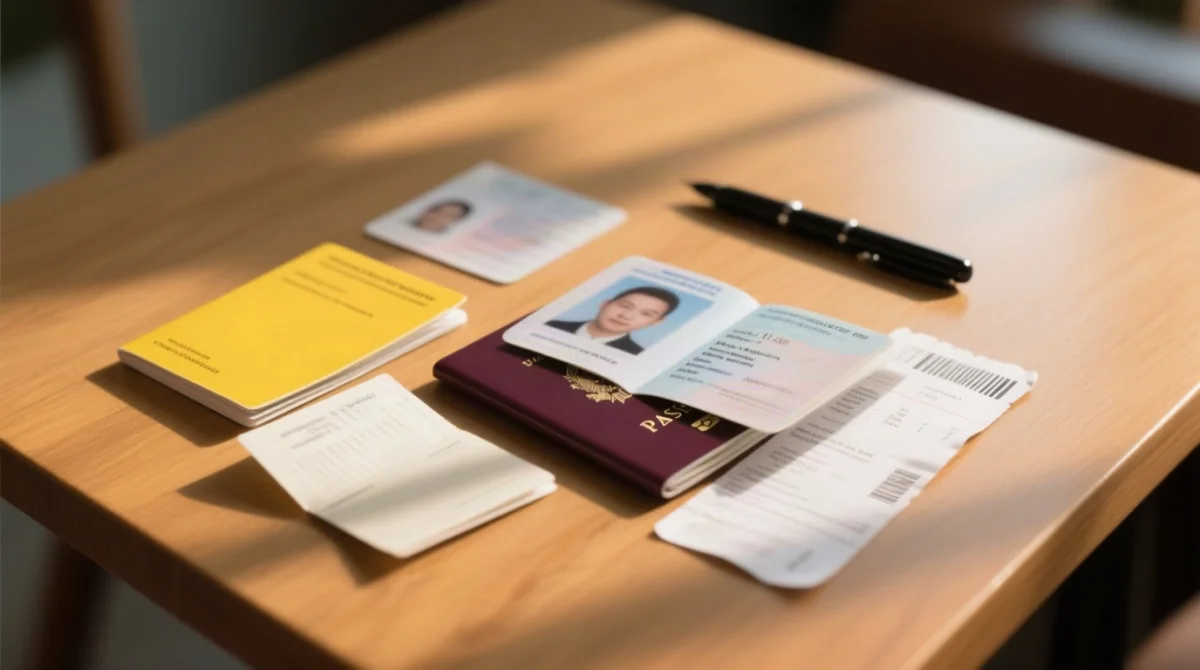
The East Africa Tourist Visa requires applicants to submit the following documents through the eVisa portal:
- Passport bio-data page scan – minimum 6 months validity from date of entry; do not crop out details or the bottom machine-readable strip.
- Digital passport photograph – white background, ears visible, taken within 6 months of application.
- Return ticket or confirmed flight booking – mandatory attachment demonstrating onward or return travel.
- Travel itinerary – mandatory attachment outlining planned movement within Kenya, Uganda, and Rwanda.
- Yellow Fever Vaccination Certificate – International Certificate of Vaccination required for entry; applicable to all travellers aged 1 year and older arriving from all countries.
All documents must be in English and uploaded in PDF, JPEG, or PNG format; verify maximum file size limits on the respective portal before submission. The East Africa Tourist Visa application may also require additional documents at immigration’s discretion during processing.
East Africa Tourist Visa UK Application: How to Apply for the eVisa East Africa Online
UK applicants submit the East Africa Tourist Visa (EATV) application online through one of three immigration portals – Uganda, Rwanda, or Kenya – with the issuing country matching the first entry point into the region.
Uganda Portal
Apply at visas.immigration.go.ug. The process involves 9 steps:
Start new application
Accept the Disclaimer
(terms and conditions)
Select visa type ‘East Africa Tourist Visa’
Complete the application form
Upload documents
(a six-digit reference number is auto-generated)
Pay the USD 100 fee
Upon approval, an approval letter is emailed
Make any required top-up payment
if applicable
Report to immigration for biometric capture
at an office or border post with uploaded documents, payment receipts, approval letter, and passport.
Rwanda Portal
For the Rwanda-issued East Africa Tourist Visa, apply at irembo.gov.rw. Select Request Type “Visa application,” then choose Visa Type V11 East Africa Visa. A group option for 4-10 people is available at USD 100. Contact the Directorate General of Immigration and Emigration at [email protected] or +250 722 17 29 74 for application queries.
Kenya Portal
For the Kenya-issued East Africa Tourist Visa, apply at etakenya.go.ke. The earliest application window is 90 days before travel; the latest is 3 days before. Standard processing takes approximately 3 business days. Support: +254 717 436 070 (phone) or +254 110 922 064 (WhatsApp). Proof of travel health insurance (US $50,000 minimum) is expected as part of the application – see the 2026 regulatory update below.
Application Tracking: How to Check Your eVisa East Africa Status
Processing takes from a few days to one week across all portals. Track your eVisa East Africa application using the reference ID and passport number on the relevant portal. Kenya: use the “Validate eTA” function on etakenya.go.ke. Uganda: enter your reference ID on visas.immigration.go.ug. Rwanda: contact the Directorate at [email protected] if no status update appears within the processing window.
eVisa East Africa Fee: How Much Does It Cost in 2026?
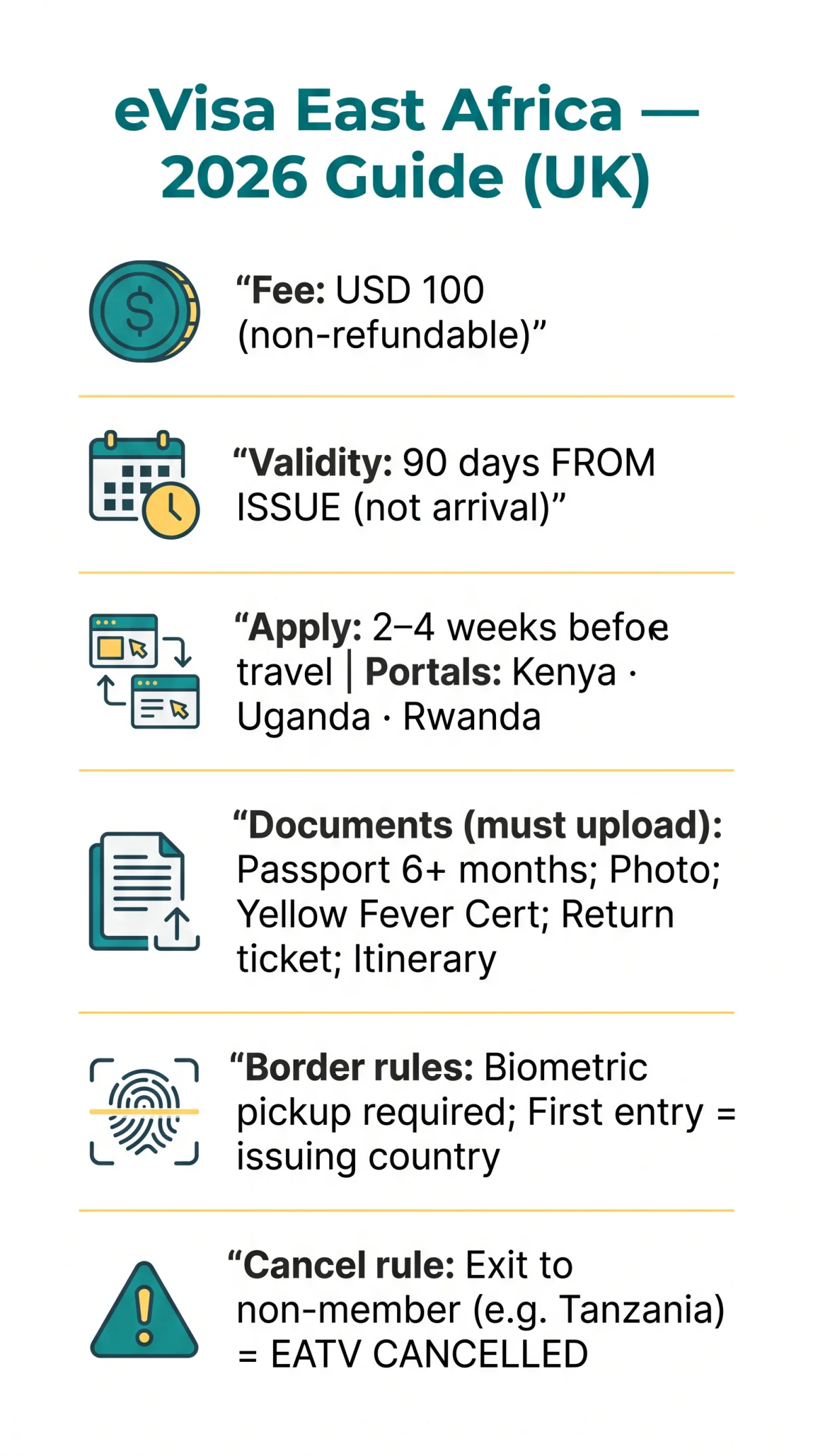
The eVisa East Africa costs a non-refundable USD 100 per person in 2026, plus potential bank surcharges for UK-issued cards.
The East Africa Tourist Visa charges a flat USD 100 fee per applicant, non-refundable even if the application is denied or withdrawn. UK travellers paying via the Rwandan High Commission London can expect a GBP equivalent of approximately £77.00, subject to exchange-rate fluctuation and possible bank or currency-conversion surcharges on UK-issued cards.
| Visa Type | Fee | Validity | Countries Covered |
|---|---|---|---|
| East Africa Tourist Visa (EATV) | USD 100 (non-refundable) | 90 days, multiple entry | Kenya, Uganda, Rwanda |
| Kenya eTA | From USD 30 | 90 days | Kenya only |
| Uganda single-entry visa | USD 50 | Single entry | Uganda only |
| Rwanda single-entry visa | USD 50 | 30 days | Rwanda only |
The East Africa Tourist Visa beats three separate USD 50 single-country visas for multi-country trips; Kenya-only travellers may prefer the eTA from USD 30.
East Africa Tourist Visa Validity and the 90-Day Countdown Problem
The East Africa Tourist Visa (EATV) is valid for 90 days from the date of issue – not from the date of arrival – with multiple entries between Kenya, Uganda, and Rwanda, and no extension possible.
The 90-day validity period starts at issuance, not arrival – 90 days is not three months. Issued on 1 September for a trip starting 15 October leaves only 75 usable days on the permit. Apply 2-4 weeks before departure to align the validity window with your travel dates.
The East Africa Tourist Visa is non-extendable and non-renewable. Once the 90 days expire, you must leave the bloc and apply for a new visa. Multiple entries are permitted freely between the three member countries, but exiting to any non-member country – including Tanzania – immediately and irreversibly cancels the EATV.
Tanzania Exclusion: What Happens If You Enter a Non-Member Country?
Tanzania and the Democratic Republic of the Congo are not part of the scheme: exiting to any non-member country immediately and irreversibly cancels the East Africa Tourist Visa – you cannot use it to re-enter the bloc.
Crossing from the Masai Mara (Kenya) to the Serengeti (Tanzania) via the Tarime-Migori border post immediately cancels your East Africa Tourist Visa. The same applies at the Namanga border crossing for day trips to Arusha from Kenya.
Decision guide:
- Planning to visit Tanzania? Apply for a separate Tanzania e-Visa (US $50 for ordinary single entry; US $100 for USA and Irish nationals) at visa.immigration.go.tz.
- Travelling only within Kenya, Uganda, and Rwanda? The East Africa Tourist Visa remains valid for multiple entries across all three countries for the full 90-day window.
- Exiting the bloc for any reason – including a day trip to Tanzania – cancels the East Africa Tourist Visa permanently. It is non-renewable and non-extendable upon exit.
eVisa East Africa vs Single-Country Visas: Which Should You Choose?
The East Africa Tourist Visa costs USD 100 and covers three countries for 90 days. Single-country alternatives range from USD 30 (Kenya eTA) to USD 50 (Uganda/Rwanda single-entry visas).
| Visa Type | Price | Validity | Entry Type | Countries Covered | Best For |
|---|---|---|---|---|---|
| East Africa Tourist Visa (EATV) | USD 100 | 90 days | Multiple entry | Kenya, Uganda, Rwanda | Multi-country trips across all three |
| Kenya eTA | From USD 30 | 90 days | Single entry | Kenya only | Kenya-only travellers |
| Kenya Single Entry Visa | USD 50 | 90 days | Single entry | Kenya only | Kenya-only (legacy option) |
| Uganda Single Entry Visa | USD 50 | 90 days | Single entry | Uganda only | Uganda-only travellers |
| Rwanda Single Entry Visa | USD 50 | 30 days | Single entry | Rwanda only | Rwanda-only travellers |
| Rwanda Visa on Arrival | USD 50 | 30 days | Single entry | Rwanda only | Last-minute Rwanda entry (available since 1 January 2018) |
Decision flowchart: Only Kenya? Kenya eTA (from USD 30). Kenya + Uganda + Rwanda? East Africa Tourist Visa (USD 100). Planning Tanzania too? The East Africa Tourist Visa does not cover Tanzania; a separate Tanzania e-Visa is required.
East Africa Tourist Visa Port of Entry Rules & Overland Travel
The East Africa Tourist Visa enforces a strict first-entry rule: whichever country issues your visa must be your first port of entry into the region. If Uganda issued your East Africa Tourist Visa, you cannot enter through Kenya or Rwanda first. This rule applies to both airport arrivals and overland crossings.
Designated land border crossings that process EATV biometric endorsements include:
- Busia and Malaba (Kenya-Uganda border)
- Cyanika and Gatuna/Katuna (Uganda-Rwanda border)
Overland travellers must carry the following documents for biometric capture at the border:
- Printed approval letter (recommended even where digital copies are accepted)
- Original passport with at least 6 months validity from date of entry
- Yellow Fever Vaccination Certificate
- Return or onward flight confirmation
- Payment receipts from the immigration portal application
Biometric capture is required at the immigration office or border post after online approval, as confirmed by the Uganda eVisa portal. At the Busia border, the process typically takes 15 minutes; officers may request a printed hotel booking confirmation, so carry a printed copy of your first night’s accommodation.
2026 Regulatory Update: Kenya Mandatory Travel Health Insurance
Effective August 2026, all non-Kenyan visitors staying less than 12 months must hold travel health insurance with a minimum of US $50,000 cumulative coverage. This requirement applies to travellers entering Kenya, including those using the East Africa Tourist Visa, and proof of insurance is expected as part of the Kenya eTA or EATV application process.
The East Africa Tourist Visa covers Kenya, Uganda, and Rwanda under a single permit, but the mandatory insurance rule applies specifically to Kenya entry. Policies from UK providers such as Aviva or World Nomads are accepted if they cover at least US $50,000 in medical expenses. Proof of this coverage is now a required attachment when applying for the East Africa Tourist Visa via the Kenya portal at etakenya.go.ke. Neither Uganda nor Rwanda has announced a comparable mandatory insurance requirement as of 2026.
This guide is verified against official government portals quarterly. If you spot an error, please contact us. Last verified: 20 July 2026.
East Africa Tourist Visa (EATV) FAQ
How do I get a visa for East Africa?
You can apply for the East Africa Tourist Visa online through one of three immigration portals: Uganda (visas.immigration.go.ug), Rwanda (irembo.gov.rw), or Kenya (etakenya.go.ke). The application requires a passport bio-data page scan, digital photograph, return ticket, travel itinerary, and a Yellow Fever Vaccination Certificate. The issuing country must be your first entry point.
How much does an East Africa visa cost?
The East Africa Tourist Visa costs a non-refundable USD 100 per person. Via the Rwanda High Commission London, the equivalent is approximately £77.00. Bank charges or currency conversion surcharges may apply for UK-issued cards. The fee is non-refundable even if the application is denied or withdrawn.
Can I get a tourist visa for Kenya and East Africa at the same time?
Yes, the East Africa Tourist Visa covers Kenya, Uganda, and Rwanda under a single permit, so you do not need a separate Kenyan visa if you hold an EATV. However, if you are only visiting Kenya, the Kenya eTA starts from USD 30, which may be a more cost-effective option for single-country trips.
How early should I apply for Kenya eTA?
For the Kenya eTA portal, the earliest application window is 90 days before travel, and the latest is 3 days before travel. It is recommended to apply at least 2 weeks ahead. The standard processing time is around 3 business days (72 hours). For the East Africa Tourist Visa, apply 2 to 4 weeks before departure to maximise the 90-day validity.
What countries does the East Africa Tourist Visa cover?
The East Africa Tourist Visa covers Kenya, Uganda, and Rwanda only. Tanzania is explicitly excluded from the scheme. If you plan to cross into Tanzania or any other non-member country, your East Africa Tourist Visa will be immediately and irreversibly cancelled, and you will need a separate visa for Tanzania.
Can I enter Uganda first with a Kenya-issued EATV?
No, the issuing country must be the first entry point into the region. If your East Africa Tourist Visa was issued by Kenya, you must enter Kenya first. If you wish to enter Uganda first, you must apply for the East Africa Tourist Visa through the Uganda immigration portal.
Do children need a separate East Africa Tourist Visa?
Yes, each traveller, including infants, needs a separate East Africa Tourist Visa application. In Rwanda, children under 16 travelling with parents holding foreign passports and a Rwandan ID are exempt from visa fees. Rwanda also offers a tourist group visa for 4 to 10 people costing USD 100.
Can I extend the East Africa Tourist Visa?
No, the East Africa Tourist Visa is non-extendable and non-renewable. It is valid for 90 days from the date of issue. Once the 90-day period expires, or if you exit the Kenya, Uganda, and Rwanda bloc to a non-member country, the visa is immediately and irreversibly cancelled.
How long is the East Africa Tourist Visa valid?
The East Africa Tourist Visa is valid for 90 days from the date of issue, not from the date of arrival. It allows multiple entries between Kenya, Uganda, and Rwanda. The 90-day countdown starts the moment immigration authorities issue the approval letter, so apply 2 to 4 weeks before departure to maximise usable days.
How long does the eVisa East Africa application take to process?
Processing time for the East Africa Tourist Visa varies by portal. The Kenya eTA portal processes applications in approximately 3 business days. The Uganda portal typically takes a few days to one week. Applications via the Rwanda High Commission London may take up to 7 working days. Track your application using the reference ID and passport number on the relevant portal.
What happens if my eVisa East Africa application is denied?
The USD 100 fee for the East Africa Tourist Visa is non-refundable even if the application is denied. You may reapply with corrected documents. Common denial reasons include passport validity under 6 months, missing Yellow Fever Vaccination Certificate, incomplete application forms, or a passport scan with the machine-readable strip cropped out. Ensure all documents are in English and in PDF, JPEG, or PNG format before resubmitting.