
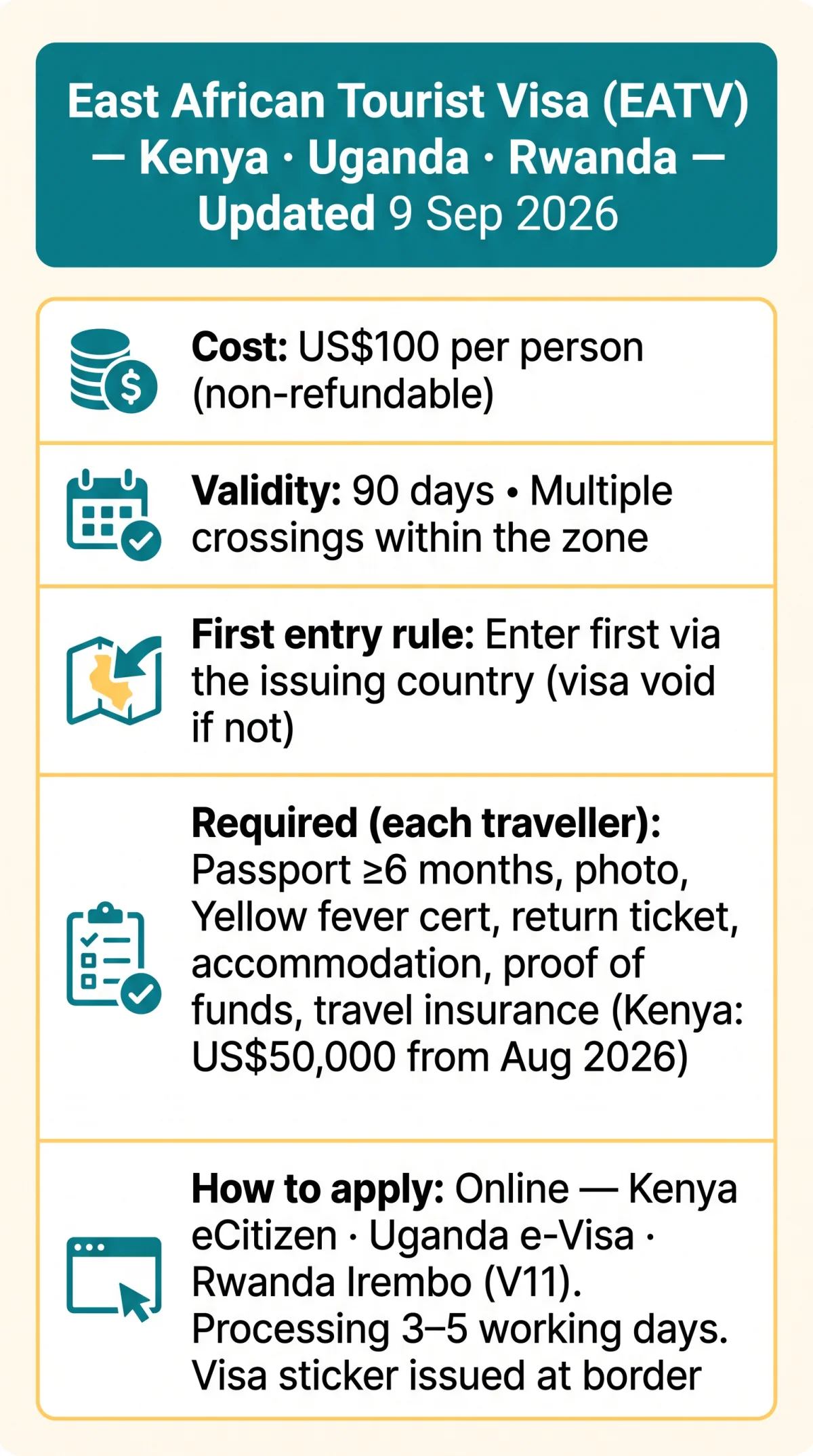
The East African Tourist Visa (EATV) covers Kenya, Uganda, and Rwanda. It costs US $100, is valid for 90 days, and allows multiple entries between the three nations. UK passport holders must first enter the country that issued the visa.
The visa requires a single application; first entry must be via the issuing country, and exiting the zone voids it. UK citizens are eligible to apply online through the immigration portals of any partner state. Each traveller, including children, needs their own individual visa.
Last updated: 9 September 2026. Next review: December 2026. We updated this guide after personally applying for the EATV via Kenya’s eCitizen portal in January 2026 and crossing the Busia border, where immigration officers verified the visa sticker in our passports.
What Is the East African Tourist Visa and Which Countries Does It Cover?
The EATV covers Kenya, Uganda, and Rwanda for tourism only (employment prohibited) and is not valid for Tanzania or other EAC states. It is a regional cooperative visa agreement between three states, not a Schengen-style visa. The physical format is a sticker in the passport, signed and stamped on a visa page.
EAC passport holders do not need the EATV. Instead, they receive a free 6-month renewable pass when crossing between partner states. Foreign residents of Kenya, Uganda, or Rwanda with valid work permits can apply for a free Interstate Pass through the respective immigration portals.
The EATV costs US $100 per person and grants 90 days of stay from the date of first entry.
Entry Rules for Travelling Between Kenya, Uganda and Rwanda
First entry must be through the issuing country; then unlimited crossings within the zone for 90 days. Exiting the zone to a non-partner country (e.g., Tanzania) voids the EATV. The visa is not renewable and cannot be extended, except in Rwanda under exceptional circumstances.
- First entry rule: The issuing country must be the first point of entry. If the EATV was applied for via Kenya’s eCitizen portal, first entry must be through Kenya. Violating this rule may result in denial of entry at the border.
- Multiple entries within the zone: The EATV allows multiple entries between Kenya, Uganda, and Rwanda during its 90-day validity. Each border crossing is stamped by immigration officers.
- Kenya-Uganda land borders: Busia, Malaba.
- Uganda-Rwanda land borders: Gatuna/Katuna, Cyanika.
- Kenya and Rwanda share no direct land border: Overland transit between them requires passage through Uganda.
- Major airports: Jomo Kenyatta International Airport (Nairobi), Entebbe International Airport (Uganda), Kigali International Airport (Rwanda).
EATV Cost and Application Process for UK Citizens
The EATV costs US $100 per person (non-refundable, even if denied or withdrawn). A bank charge of 2 to 3 percent typically applies to international card transactions. UK citizens can apply online via eCitizen (Kenya), visas.immigration.go.ug (Uganda), or irembo.gov.rw (Rwanda, visa type code V11). A postal application through the Rwandan High Commission in London costs £77 (processing: 7 working days; phone: +44 (0)207 224 9832).
120-122 Seymour Place, London, W1H 1NR Log in & start application
Log into the chosen portal and start a new application; accept terms and conditions.
Select visa type
Select visa type, category, and sub-category (e.g., “East African Tourist Visa” on eCitizen; V11 on Irembo).
Complete form & pay
Complete the form, upload required documents (each traveller, including children, requires a separate EATV), and pay the US $100 fee.
Receive approval & collect sticker
Receive the approval letter by email within 3 to 5 working days; report to immigration at the border for biometric capture and visa sticker issuance.
2026 Entry Requirements and Document Checklist
From August 2026, Kenya requires all non-Kenyan visitors (including EATV holders) staying less than 12 months to hold travel health insurance with a minimum US $50,000 cumulative cover. Proof must be submitted during the Kenya eTA application. UK policies from providers like Barclays, Post Office, or Staysure qualify if they meet the threshold. Uganda and Rwanda do not currently have this requirement.

The EATV requires the following documents from every applicant:
- Passport valid for at least 6 months with ≥2 blank pages
- Recent passport-size photograph (white background, ears visible)
- Yellow fever vaccination certificate (mandatory for all three countries, age ≥1 year)
- Return ticket and travel itinerary
- Proof of sufficient funds (e.g., UK bank statement)
- Accommodation proof or host ID copy
- Travel insurance meeting Kenya’s US $50,000 minimum (from August 2026)
| Option | Fee per person | Coverage | Validity |
|---|---|---|---|
| East African Tourist Visa | US $100 | Kenya, Uganda, Rwanda | 90 days |
| Three individual visas | US $150 ($50 × 3) | Same three countries | 90 days each |
Source: Fee schedules from Kenya eCitizen, Uganda e-Visa, and Rwanda Irembo (accessed September 2026).
FAQ
Which countries are included in the East African Tourist Visa?
The EATV covers Kenya, Uganda, and Rwanda. Tanzania and other East African Community states are not part of this visa scheme.
What are the entry rules between the three partner countries?
First entry must be through the issuing country. After that, you can cross borders between Kenya, Uganda, and Rwanda as many times as you wish within the 90-day validity period. Exiting the zone to a non-partner country voids the visa.
How much does the East African Tourist Visa cost in 2026?
The visa costs US $100 per person (non-refundable). A bank charge of 2 to 3 percent typically applies to international card transactions. Each traveller, including children and infants, must obtain their own individual visa.
Is the EATV single-entry or multiple-entry?
The visa is single-entry into the East African zone but permits multiple entries between Kenya, Uganda, and Rwanda. If you exit the zone to a non-partner country like Tanzania, the visa becomes void and you must apply for a new one.
Do UK citizens need a visa for East African visa countries?
Yes, UK passport holders must apply for the EATV online. Alternatively, UK citizens can get a free 30-day visa on arrival in Rwanda due to Commonwealth membership, but this does not cover Kenya or Uganda. Applications take 3 to 5 working days to process.
Can I extend the East African Tourist Visa if it expires mid-trip?
The EATV is generally not extendable. Rwanda offers a 5-day grace period after expiry without penalty; after that, penalties apply. Extensions must be requested at the Directorate General of Immigration and Emigration offices before the visa expires.
Is travel insurance mandatory for East African visa countries?
From August 2026, Kenya requires all non-Kenyan visitors to hold travel health insurance with a minimum US $50,000 cover. Uganda and Rwanda do not have this requirement.
Can I travel to Tanzania with the East African Tourist Visa?
No, the EATV is strictly limited to Kenya, Uganda, and Rwanda. If you travel to Tanzania, your EATV will be voided upon exit, and you will need to apply for a new visa to return.
If you spot an error or know of a recent change, please contact us. We correct mistakes within 24 hours.