
Last reviewed: September 2026. Next review due: March 2027. East Africa visa health requirements for UK tourists centre on a valid yellow fever vaccination certificate. The EATV costs US $100 (90-day multiple entry for Kenya, Uganda, Rwanda). From August 2026, Kenya mandates travel health insurance with minimum US $50,000 cover.
What Is the East Africa Tourist Visa (EATV)?
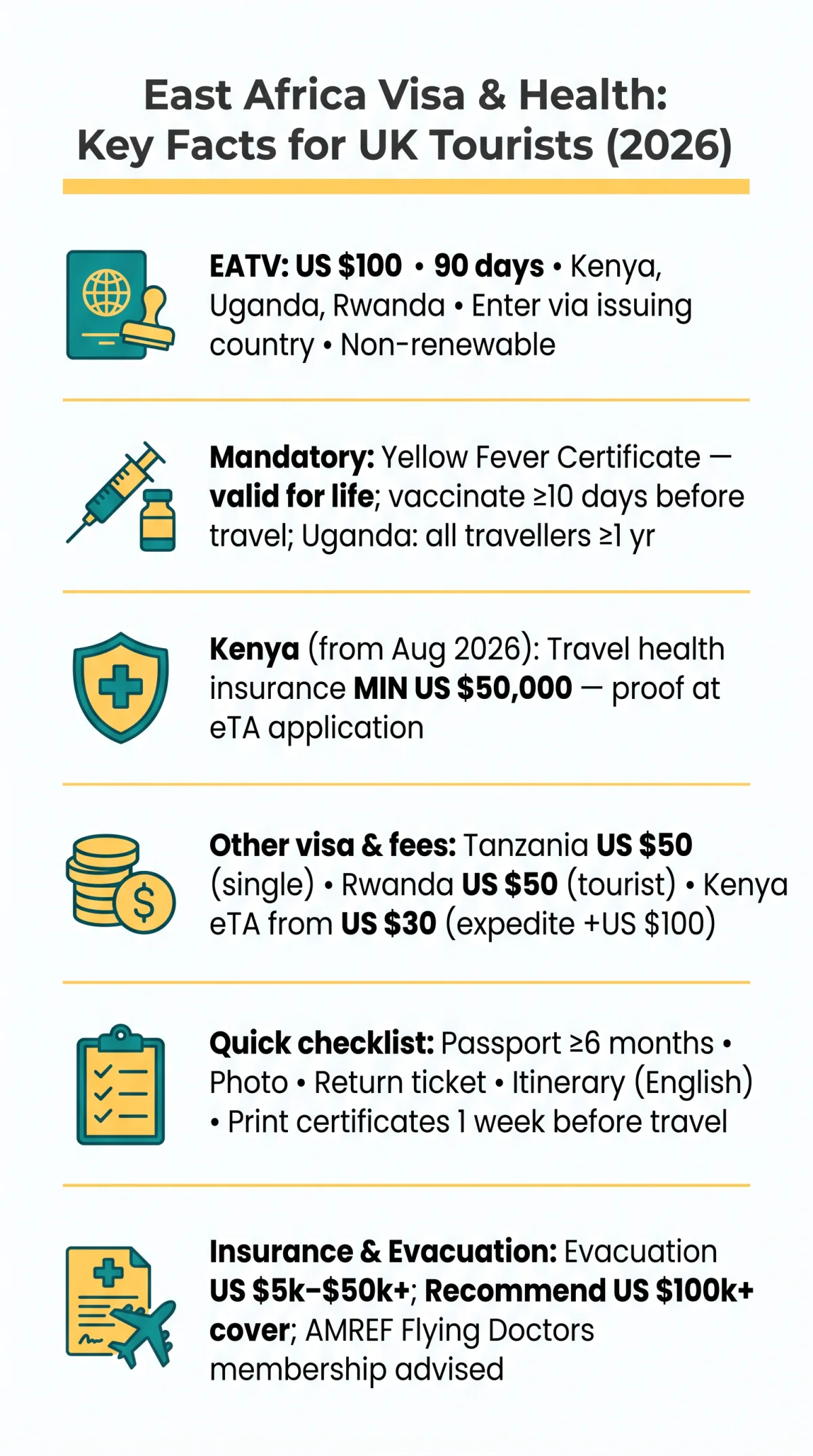
East Africa visa health requirements begin with the East Africa Tourist Visa (EATV): it costs US $100, grants 90-day multiple-entry access to Kenya, Uganda, and Rwanda only, and is non-renewable. You must enter via the issuing country first. Required documents include a passport bio-data page copy (minimum 6 months validity), recent passport photograph, return ticket, and travel itinerary, all in English. Departing the three-country zone immediately voids the visa; re-entry requires a new visa or entry authorisation.
East Africa visa health requirements also involve Tanzania, which operates a separate visa system (US $50 single entry; US $100 for USA/Ireland nationals) via visa.immigration.go.tz. Kenya uses the Electronic Travel Authorisation (eTA) via etakenya.go.ke (standard fee from US $30; expedited service US $100 additional). Rwanda offers visa on arrival at Kigali International Airport and all land borders (US $50 tourist visa; US $100 multiple entry). AU and Commonwealth citizens receive 30 days free of charge.
Mandatory Health Documents for Your East Africa Visa Application
East Africa visa health requirements centre on the yellow fever vaccination certificate. Country-specific enforcement applies:
| Country | Requirement | Exception | Who Needs It |
|---|---|---|---|
| Uganda | All travellers aged ≥1 year | None | Everyone |
| Kenya | Arriving from or transiting >12H in WHO-endemic countries | Direct from non-endemic country | Conditional |
| Tanzania | Arriving from or transiting >12H in WHO-endemic countries | Direct from non-endemic country | Conditional |
| Rwanda | Border discretion; stricter during outbreaks | Check before travel | Case-by-case |
The certificate is valid for life per current WHO guidelines. Schedule vaccination at least 10 days before travel at a UK Yellow Fever Vaccination Centre (NHS, MASTA, Fit for Travel, Boots, Superdrug). Travellers with medical contraindications (egg allergy, immunosuppression, thymus disorder, age >60 per WHO ICVP regulations) can obtain a medical exemption waiver at the same centres.
Polio vaccination is mandatory only for travellers from WHO polio-endemic countries; the UK is not on this list. Countries like India may require an oral polio certificate after visiting Kenya or Uganda. COVID-19 entry rules were largely lifted by 2026; confirm the current position on each country’s eVisa portal before travel.
Recommended Vaccinations and Preparation Timeline
East Africa visa health requirements do not mandate Hepatitis A, Typhoid, Hepatitis B, or Rabies, but the CDC and WHO strongly recommend them. Hepatitis B is transmitted via blood and bodily fluids, not contaminated food or water (that is Hepatitis A).
| Vaccine | Status | Doses | Timing | UK Cost* |
|---|---|---|---|---|
| Hepatitis A | Recommended | 2 | ≥2 weeks before | ~£50-70 |
| Hepatitis B | Recommended | 3 | ≥6 weeks before | ~£50-60/dose |
| Typhoid | Recommended (booster every 3 years) | 1 | ≥2 weeks before | ~£30-40 |
| Rabies (pre-exposure) | For gorilla trekking | 2 | ≥1 week apart | ~£50-65/dose |
| Cholera (oral) | High-risk rural areas | 2 | ≥2 weeks apart | ~£30-40/dose |
| Tetanus/Tdap | Recommended (booster every 10 years) | 1 (if last >8 years) | ≥2 weeks before | ~£30-50 |
*Prices as of 2026 based on MASTA and Boots UK Travel Clinic price lists. Verify at time of booking.
Schedule appointments
4-6 weeks before departure
Get vaccinations
Via your GP, MASTA, or Fit for Travel
Collect certificates
2-3 weeks before departure
Print copies
1 week before travel
Key Health Risks: Malaria, Altitude, and Disease Prevention
East Africa visa health requirements do not mandate malaria prophylaxis, but UK tourists should obtain a prescription via a GP, MASTA, or Fit for Travel clinic before departure. Three main options:
| Drug | Start Before Travel | Continue After Return | Key Side Effects |
|---|---|---|---|
| Atovaquone/Proguanil (Malarone) | 1-2 days | 7 days | Few; costlier option |
| Doxycycline | 1-2 days | 4 weeks | Photosensitivity, GI upset |
| Mefloquine | 2-3 weeks | 4 weeks | Neuropsychiatric effects |
Use DEET ≥30% repellent against both night-biting Anopheles and daytime Aedes mosquitoes that transmit Dengue and Chikungunya. Peak risk in rainy seasons: late March to May, late October to December.
East Africa visa health requirements also involve non-vaccination risks: schistosomiasis exists at Lake Victoria, Lake Bunyonyi, and the Nile near Jinja. Activity-risk mapping: wading in Lake Victoria shallows – high; white-water rafting on the Nile near Jinja – moderate; swimming in Lake Bunyonyi – low. Avoid freshwater exposure in endemic zones.
For trekking above 2,500 m on Kilimanjaro (5,895 m), Mount Kenya (5,199 m), or the Rwenzori Mountains (5,109 m), carry Acetazolamide (Diamox) and plan acclimatisation days. Travellers carrying prescribed or controlled medications must present an English-language doctor’s letter with medications in original packaging.
Travel Insurance: New Requirements and Safari Evacuation
East Africa visa health requirements now extend into mandatory insurance: Kenya requires all non-Kenyan visitors staying under 12 months to hold travel health insurance with minimum US $50,000 cumulative cover from August 2026, verified during the eTA application at etakenya.go.ke. Zanzibar enforces separate mandatory insurance for non-residents since 1 October 2024 via visitzanzibar.go.tz.
- Medical evacuation from remote parks like Serengeti, Masai Mara, or Bwindi costs $5,000-$50,000+; standard UK policies often exclude helicopter transfers. Seek minimum $100,000+ cover.
- AMREF Flying Doctors offers supplementary air-ambulance membership across the region.
- No NHS reciprocal agreements exist; upfront private payment is mandatory. A Nairobi appendectomy costs $2,000-$5,000.
- Before purchase, verify your policy covers remote-area evacuation, adventure activities, pre-existing conditions, and trip curtailment.
Frequently Asked Questions (FAQ)
What vaccinations are required for a Kenya, Uganda, or Rwanda visa from the UK in 2026?
A yellow fever vaccination certificate is the primary mandatory document. Uganda requires it for all travellers aged ≥1 year. Kenya and Tanzania require it only if arriving from or transiting >12 hours through WHO-endemic countries. Rwanda may require it at the border. Recommended vaccines include Hepatitis A, Typhoid, and Rabies. For the current list of WHO-endemic countries, check the WHO International Travel and Health guidelines.
Is the COVID-19 vaccination still required for East African visa applications in 2026?
COVID-19 entry rules were largely lifted across East Africa by 2026. Historically, vaccination proof or a negative PCR test was required. Confirm the current position on each country’s eVisa portal before travel.
Do UK tourists need a polio vaccination certificate for entry to East African countries?
Polio vaccination is mandatory only for travellers arriving from WHO polio-endemic or affected countries. The UK is not on this list. If you plan to travel to countries like India after visiting Kenya or Uganda, you may need an oral polio certificate for your next destination.
Where can I get a yellow fever vaccination certificate in the UK before travelling to East Africa?
Obtain it at a designated UK Yellow Fever Vaccination Centre: NHS clinics, MASTA, Fit for Travel clinics, or select pharmacies like Boots or Superdrug. The certificate is valid for life. Schedule at least 10 days before your trip.
How long before my East Africa trip should I schedule vaccinations and doctor visits?
Schedule appointments at least four to six weeks before departure. Finalise all health documents and print copies one week before travel.
What travel insurance covers medical evacuation from East African safari destinations?
Standard UK policies exclude helicopter evacuation ($5,000-$50,000+ from Serengeti or Bwindi). Buy a policy with $100,000+ evacuation cover or add AMREF Flying Doctors membership.
What are the best travel insurance options for UK tourists with pre-existing conditions?
Declare pre-existing conditions to your UK insurer, then verify the policy covers remote-area evacuation, trekking, and trip curtailment. Without NHS reciprocal agreements, upfront private payment is mandatory.
What happens if I leave the EATV three-country zone and try to re-enter on the same visa?
The EATV grants multiple entry only within Kenya, Uganda, and Rwanda. Leaving the zone voids the visa; re-entry requires a new visa or entry authorisation.
This article is for general informational purposes only and does not constitute medical or legal advice. Always verify requirements with official embassies and your healthcare provider before travel. Prices subject to change.