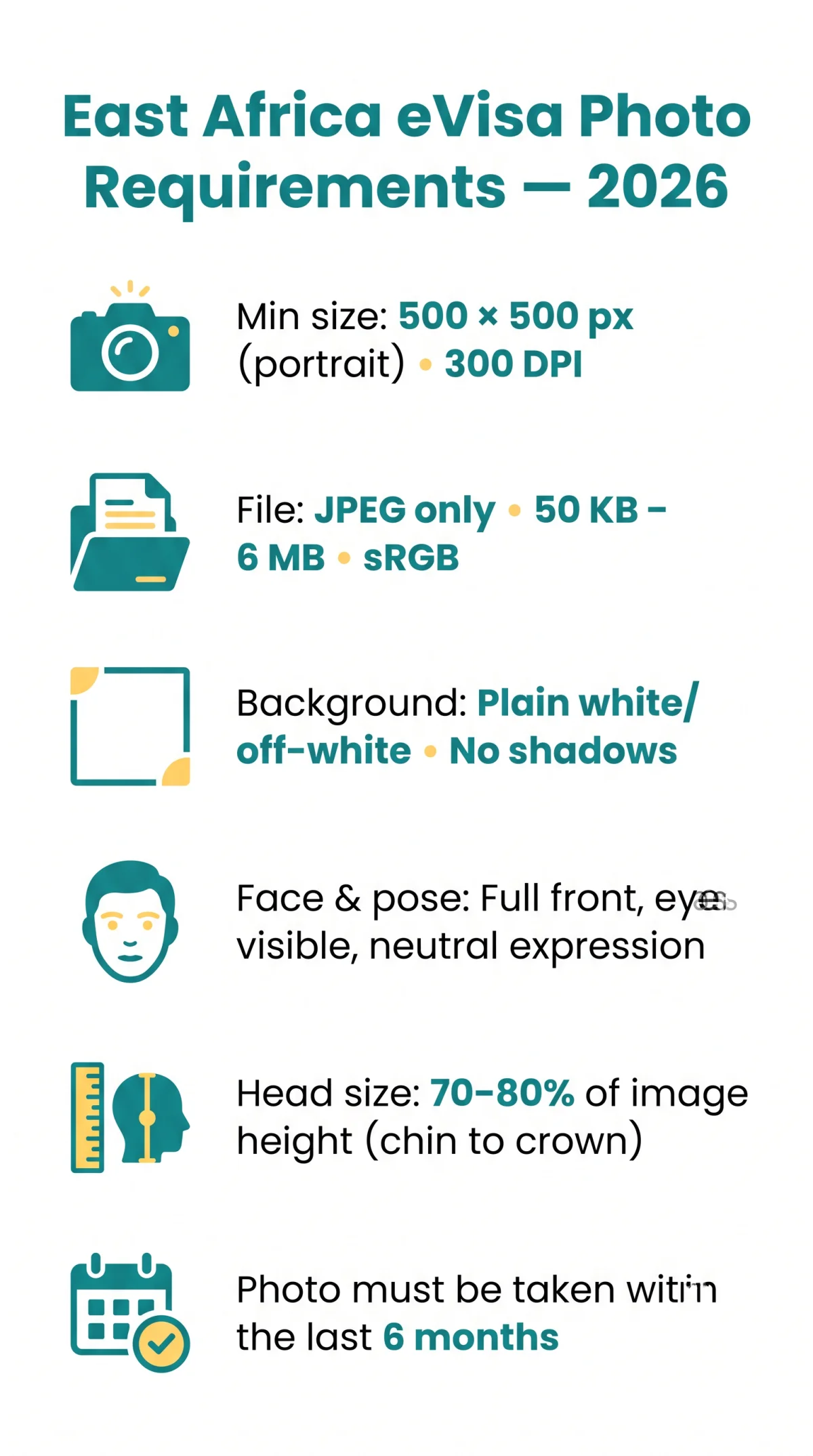
To meet the photo requirements East Africa eVisa applications demand, your digital image must measure at least 500 x 500 pixels, use a plain white or off-white background, and be saved as a JPEG file. The file size must fall between 50 KB and 6 MB to ensure acceptance.
A photo that deviates from these specifications (dimensions, file format, background colour) will be rejected by the upload system. Use the checklist below to verify compliance.
Last reviewed: September 2026. These requirements are based on guidelines published by the Uganda Directorate of Citizenship and Immigration Control, the Kenya eTA portal, and Rwanda Irembo, cross-referenced with UK Visas and Immigration photo guidance (published 12 February 2026). Visa photo rules may change without notice; always verify on the relevant portal before submitting.
Technical Specifications: Dimensions, Format, and File Size
Minimum 500 × 500 pixels, recommended 300 DPI, portrait orientation, no mirror/flip. Selfie cameras often produce mirrored images; check before uploading. The physical crop equivalent is 35 × 45 mm (approximately 2 × 2 inches), the standard passport-photo framing.
Accepted file format: JPEG / JPG only. PNG, HEIC, and HEIF files will be rejected. File size must fall between 50 KB (minimum) and 6 MB (maximum). The colour space should be sRGB; avoid CMYK profiles that render incorrectly on screen. Applicants can use any basic photo-editing tool to resize, crop, and export to JPEG before uploading.
Appearance and Pose: Background, Lighting, and Framing
The East Africa eVisa passport photo specifications require a solid plain white or off-white background (approximately RGB 255, 255, 255), with no patterns, textures, or grey tones. The background must be uniform, and the photo must be in full colour, not black and white.
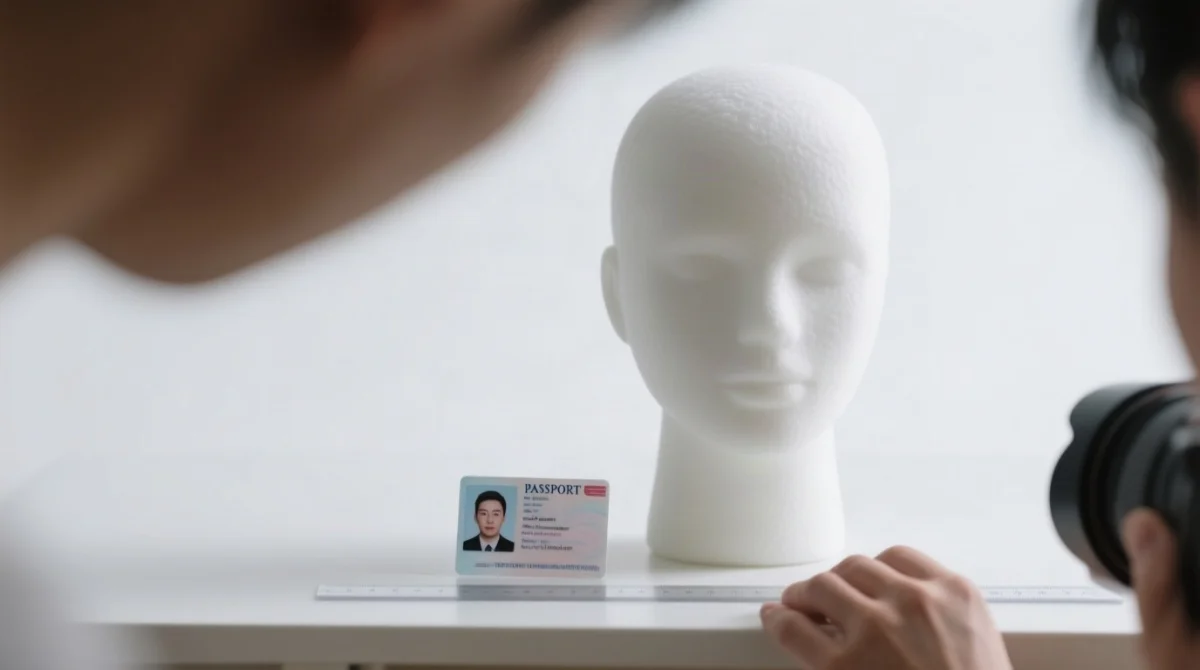
Full face, front view, no tilt. Eyes must be open and clearly visible, looking directly into the camera lens, mouth closed, expression neutral. The face should occupy 70-80% of the image height (chin to crown), with adequate headroom above the top of the head, which must not be cropped.
Lighting must be even and diffused, with zero shadows on the face and none cast behind the subject. No red-eye effect, no other objects or people in the frame. Hair must not cover the eyes.
Glasses, Headwear, and Authenticity Rules
Glasses allowed only if eyes are fully visible, frames do not cover eyes, and there is no glare. Tinted or dark glasses require a medical certificate. Headwear that obscures the hair or hairline is prohibited; religious attire worn daily is permitted provided the full face from hairline to chin stays visible. Dress code: normal street attire, shoulders and torso clothed; uniforms not allowed. Hearing devices and wigs should be worn if normally worn.
The image must have been taken within the past 6 months and reflect the applicant’s current appearance. Scanning or photographing the picture inside a passport is explicitly prohibited, and the uploaded photo must not be the same image already appearing in a passport or identity card. Any alteration through computer software, filters, AI enhancement, or background replacement renders the photo non-compliant.
Country-Specific Portals, Visa Context, and Child Photo Guidelines
The EATV, introduced in 2014, covers Kenya, Uganda, and Rwanda only. The visa costs USD 100 (non-refundable, plus bank charges), is valid for 90 days from the issue date, allows multiple entries for tourism, and is not extendable or renewable. The first entry point must be the issuing country. Employment is prohibited. A return ticket and travel itinerary are required. Yellow fever vaccination is mandatory for Uganda; Kenya and Rwanda require it when arriving from endemic countries.
Travellers submit via the Uganda Directorate of Citizenship and Immigration Control portal, the Kenya eTA portal, or the Rwanda Irembo portal. Tanzania is not part of the EATV; travelling there invalidates the visa, and Tanzania operates a separate system at visa.immigration.go.tz.
The Uganda Directorate of Citizenship and Immigration Control is located at Plot 65/67, Old Port Bell Road, Kampala, Uganda. Phone: +256 417 102 600.
Children: alone in frame. Under 6: no need to look at camera or have a plain expression. Under 1: eyes may be closed, can lie on a light sheet (photo from above); a supporting hand must not appear. No toys or dummies.
FAQ: East Africa eVisa Photo Requirements
What are the exact pixel dimensions for the East Africa eVisa photo?
The minimum pixel dimensions are 500 x 500 px, and the image must be in portrait orientation. Resolution should be 300 DPI.
What background colour is required for the eVisa photo upload?
A solid plain white or off-white background (approximately RGB 255, 255, 255), with no patterns, textures, or grey tones, and zero shadows cast behind the subject.
Can I wear glasses in my East Africa eVisa photo?
Prescription glasses are permitted if eyes are clearly visible, frames do not cover eyes, and there is no glare. Tinted or dark glasses require a medical certificate.
Is it acceptable to scan my current passport photo for the eVisa application?
No. Scanning or photographing the photo in your passport is explicitly prohibited. The image must be a fresh digital photograph taken within the past 6 months.
What file format and size limits apply to the eVisa photo upload?
JPEG or JPG format only (no PNG, HEIC, or HEIF). File size must be between 50 KB and 6 MB. Colour space should be sRGB.
Are there different photo rules for babies and young children?
Children under 6 do not need to look at the camera or have a plain expression. Children under 1 can have eyes closed and lie on a light sheet (photo from above); a supporting hand must not be visible. No toys or dummies.
Can I edit or filter my eVisa photo using computer software?
No. The photograph must not be altered by software, filters, AI enhancements, or background replacement. Everyday cosmetics are acceptable if they do not alter facial proportions.
Does the East Africa Tourist Visa cover travel to Tanzania?
No. The EATV covers Kenya, Uganda, and Rwanda only. Tanzania is not part of the EATV; travelling there invalidates the visa. Tanzania has its own separate visa system.