
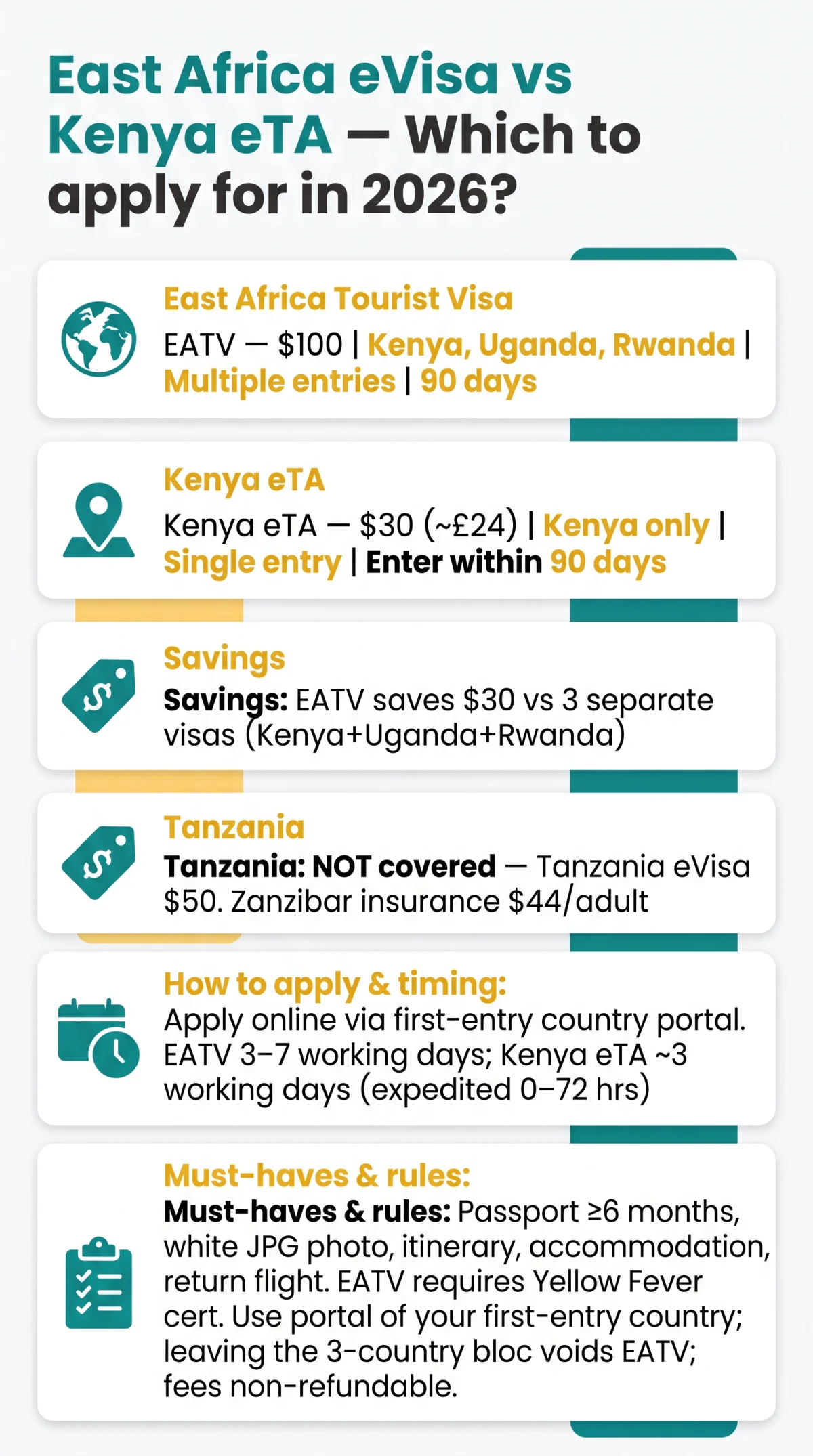
When weighing the East Africa eVisa vs Kenya eTA, the choice depends on your itinerary. The EATV costs $100 USD and covers Kenya, Uganda, and Rwanda with multiple entries over 90 days. The Kenya eTA costs $30 USD (approximately £24 GBP) for a single entry to Kenya alone. For UK travellers planning a multi-country East African safari, the EATV saves $30 compared to purchasing three individual visas ($130 total). However, the EATV covers only Kenya, Uganda, and Rwanda. Tanzania always requires a separate eVisa ($50 USD) regardless of whether you hold an EATV. Leaving the three-country bloc also invalidates the EATV immediately. Kenya replaced its visa-on-arrival system with the eTA in January 2024. UK passport holders are not exempt and must apply online before departure.
Published: 15 January 2026. Last reviewed: 9 September 2026. All fees, portal URLs, and processing times verified against the official government sources cited inline.
East Africa eVisa vs Kenya eTA at a Glance
The EATV costs $100 USD and covers Kenya, Uganda, and Rwanda with multiple entries over 90 days. The Kenya eTA costs $30 USD (approximately £24 GBP) and allows a single entry to Kenya alone.
| Feature | EATV | Kenya eTA |
|---|---|---|
| Cost | $100 USD | $30 USD (approximately £24) |
| Countries | Kenya, Uganda, Rwanda | Kenya only |
| Entry type | Multiple-entry within bloc | Single-entry |
| Validity | 90 days from issue | 90 days from issue to enter |
| Processing | 3-7 working days | ~3 working days (expedited: instant-72 hrs) |
| Purpose | Tourism only | Tourism only |
| Refund | Non-refundable | Non-refundable |
| Itinerary | Required permits | Total cost | Savings vs individual | UK recommendation |
|---|---|---|---|---|
| Kenya only | Kenya eTA | $30 | – | Recommended |
| Kenya + Uganda + Rwanda | EATV | $100 | $30 saved | Best value for 3-country trips |
| Kenya + Tanzania | Kenya eTA + Tanzania eVisa | $80 | – | Recommended |
| Kenya + Uganda + Rwanda + Tanzania | EATV + Tanzania eVisa | $150 | $30 saved | Add Zanzibar insurance ($44/adult) |
Tanzania is never included in the EATV – a separate $50 Tanzania eVisa is always required. Zanzibar adds $44 USD mandatory travel insurance per adult.
What Is the East Africa Tourist Visa (EATV)?
The EATV launched in 2016 covers Kenya, Uganda, and Rwanda for $100 USD. It remains valid for 90 calendar days from the date of issue and permits multiple entries within the Kenya-Uganda-Rwanda bloc for tourism purposes only. Employment is prohibited, and the EATV is neither extendable nor renewable.
Kenya withdrew from the EATV scheme in 2024; verify current availability on the portal of your first-entry country (status per kenyarep-jp.com). The Uganda National Citizenship and Immigration Control board (NCIC), located at Plot 65/67, Old Port Bell Road, Kampala, Uganda (phone +256 417 102 600), administers the Uganda portal at visas.immigration.go.ug.
Two rules govern EATV usage. The first-entry rule requires you to physically enter the country whose portal issued your EATV first: Uganda (visas.immigration.go.ug), Kenya (etakenya.go.ke), or Rwanda (irembo.gov.rw). Applying via the Uganda portal but flying into Nairobi invalidates the EATV. The exit invalidation rule cancels the EATV the moment you leave the three-country bloc: a day trip from Kenya to Tanzania terminates the visa, preventing re-entry to Uganda or Rwanda.
What Is the Kenya eTA?
The Kenya Electronic Travel Authorization (eTA) replaced Kenya’s visa-on-arrival system in January 2024. The Standard eTA costs $30 USD (approximately £24 GBP) for single-entry and grants 90 days from date of approval to enter. UK passport holders MUST apply via etakenya.go.ke (payment: Visa, Mastercard, Apple Pay). Support: WhatsApp +254 110 922 064, phone +254 717 436 070.
Additional types include the Transit eTA ($20 USD, max 72 hours), a 1-Year Multiple Entry eTA ($300 USD), and an Expedited eTA ($100 USD, instant to 72 hours). Each traveller, including children under 18, requires a separate application. Exempt: air transit passengers not leaving the airport, ship passengers, British Military serving members, Kenya Permanent Residence holders, and valid Work Permit holders. The Kenya eTA does not guarantee entry; an immigration officer decides on arrival. The UK Home Office eTA is separate from Kenya’s eTA.
How to Apply for the EATV or Kenya eTA
Both the EATV and Kenya eTA are obtained online through government portals. Required: passport (6 months validity), photo (white background, JPG), itinerary, accommodation, return flight. EATV also requires a yellow fever vaccination certificate.

EATV: apply via first-entry country portal (e.g., visas.immigration.go.ug for Uganda).
Log in
Access the portal of your first-entry country.
Accept terms
Review and agree to the application conditions.
Select visa type
Choose the East Africa Tourist Visa option.
Complete form
Fill in all required personal and travel details.
Upload docs
Submit documents to receive a 6-digit reference number.
Pay $100 USD
Complete payment via the portal.
Await emailed approval letter
Receive your EATV approval by email.
At border: present passport, approval letter, and receipts for biometric capture. Apply at least 2 weeks ahead; processing takes 3-7 working days.
Kenya eTA: apply via etakenya.go.ke. Create account, fill form, upload passport scan and photo, pay $30 USD, receive digital approval. Standard processing: ~3 working days; Expedited option ($100 USD) returns a decision instantly to within 72 hours. Submit at least 3 days before travel, up to 3 months ahead.
All fees are non-refundable. Avoid third-party services that charge markups for submitting the same government form.
Common Mistakes to Avoid When Choosing EATV or Kenya eTA
Costliest errors: wrong portal, assuming Tanzania is covered, overpaying for Kenya-only trip.
- Applying for the EATV through the wrong portal – the issuing country must be your first port of entry (Uganda: visas.immigration.go.ug; Rwanda: irembo.gov.rw; Kenya: etakenya.go.ke)
- Assuming the EATV covers Tanzania – it does not; a separate Tanzania eVisa costs $50 USD
- Showing up at the border without valid authorisation – no visa-on-arrival exists for most nationalities
- Paying $100 USD for the EATV when only Kenya is on the itinerary (wasting $70 vs the $30 USD Kenya eTA)
- Double-paying after a portal timeout – check application status via the portal’s validate feature before re-submitting
- Forgetting passport expiry – minimum 6 months validity required for both products
- Collecting luggage at JKIA during transit and needing a Standard eTA ($30) instead of a Transit eTA ($20, max 72 hours)
- Using third-party agents and paying inflated fees for the same government form
- Applying fewer than 3 days before travel for the Kenya eTA
- Dual nationality holders switching passports mid-trip – the EATV is tied to one passport; use it throughout
If an application is rejected, fees are non-refundable and no formal appeals process exists. Re-apply with corrected information, or fall back to individual country eVisas (Uganda $50, Rwanda $50).
Health Requirements and Tanzania Integration
The EATV and Kenya eTA share some health rules, but Uganda imposes the strictest requirement: a mandatory Yellow Fever vaccination certificate for all travellers over age one. Kenya, Tanzania, and Rwanda require it only when arriving from a Yellow Fever endemic country. Rwanda additionally demands a negative PCR test within 72 hours prior to travel for primate tourism (gorillas or chimpanzees). COVID-19 vaccination or testing is not required anywhere in the region in 2026.
Tanzania excluded: requires separate eVisa ($50 single, $100 multiple for US). Apply at least 3 weeks ahead via visa.immigration.go.tz. Entering Tanzania invalidates the EATV immediately.
Zanzibar: mandatory insurance $44/adult, $22/child (3-17), free under 2. Buy at visitzanzibar.go.tz – QR code required at customs.
If the EATV is unavailable, individual eVisas serve as fallbacks: Uganda at $50 USD (2-5 working days) and Rwanda at $50 USD (4-7 working days, with Visa on Arrival available for many nationalities).
East Africa eVisa vs Kenya eTA FAQ
Do UK citizens need an eTA for Kenya in 2026?
Yes. UK passport holders are not exempt and must obtain a Kenya eTA before travel. The Standard eTA costs $30 USD (approximately £24 GBP) via etakenya.go.ke. Processing takes approximately 3 working days, with a minimum application deadline of 3 days before departure.
Is the East Africa Tourist Visa still available in 2026?
Availability varies by portal. The EATV may be temporarily unavailable through the Kenya portal (kenyarep-jp.com data). Verify current status on the portal of your first-entry country before applying. If unavailable, fall back to individual country eVisas (Uganda $50 USD, Rwanda $50 USD).
Can I use the EATV to visit Tanzania?
No. Tanzania requires a separate eVisa ($50 USD for ordinary single entry) in addition to the EATV. Zanzibar also requires mandatory travel insurance at $44 USD per adult, purchased before arrival.
Is the Kenya eTA single-entry or multi-entry?
The Standard Kenya eTA ($30 USD) is single-entry. A 1-Year Multiple Entry eTA ($300 USD) is available for frequent travellers. An Expedited eTA ($100 USD) provides instant to 72-hour approval. A Transit eTA ($20 USD) allows stays up to 72 hours.
What happens if I enter Kenya first but applied for the EATV through the Uganda portal?
The EATV will be invalid. You must physically enter the country whose portal issued your EATV first. If you applied through the Uganda portal but fly into Nairobi, your EATV is not valid. Apply through the Kenya portal if Kenya is your first entry point, or obtain a Kenya eTA instead.
How far in advance should I apply?
Kenya eTA: at least 3 days before travel (standard ~3 working days). EATV: at least 2 weeks ahead (3-7 working days). Tanzania eVisa: at least 3 weeks ahead (up to 10 working days). Never book non-refundable flights before receiving approval.
What if my eTA or EATV application is rejected?
Fees are non-refundable for both the EATV ($100 USD) and Kenya eTA ($30 USD). There is no formal appeals process. Re-apply with corrected information. If the EATV is unavailable or rejected, fall back to individual country eVisas: Uganda ($50 USD) or Rwanda ($50 USD).
Can I apply for my whole family in one Kenya eTA submission?
No. Each traveller requires a separate application and individual $30 USD fee. Children under 18 must have a separate application submitted by a legal guardian, parent, or accompanying adult.
I’m transiting through Nairobi JKIA. Do I need an eTA?
If you stay airside without clearing immigration, no eTA is required. If you collect baggage, exit the secure area, or leave the airport, you need at minimum a Transit eTA ($20 USD, max 72 hours) or a Standard eTA ($30 USD).
How do I pay for my EATV or Kenya eTA from the UK?
The Kenya eTA portal accepts Visa, Mastercard, and Apple Pay. The Uganda NCIC portal and Rwanda Irembo portal accept major credit and debit cards. Pay in USD to avoid dynamic currency conversion markups. Expect potential cross-border transaction fees. All fees are non-refundable.
Note: Visa policies change frequently. Always verify current status on the official portal of your first-entry country before applying. This article was accurate as of September 2026.