
UK travellers flying direct to East Africa do not need a yellow fever certificate for the East Africa Tourist Visa. Uganda mandates the certificate for all arrivals regardless of origin, while Kenya and Rwanda require it only if you have visited or transited 12 hours or more through a WHO-listed yellow fever risk country.
The requirement hinges on your travel history, not your nationality. Immigration officers at Entebbe, Jomo Kenyatta, and Kigali airports assess your point of departure and any transit stops of 12 hours or longer in a WHO-endemic country. Only the original physical ICVP booklet is accepted at the border; digital copies, PDF scans, and NHS App records are not recognised.
Reviewed on 9 September 2026 against WHO International Travel and Health, NaTHNaC country advice, and IHR 2005 Annex 7. Border rules can change without notice; reconfirm before departure.
When Is a Yellow Fever Certificate Mandatory for EATV Applicants?
The yellow fever certificate East Africa requirement depends on travel history: Uganda checks all arrivals, while Kenya and Rwanda check only if you arrived from or transited 12+ hours through a WHO risk country.
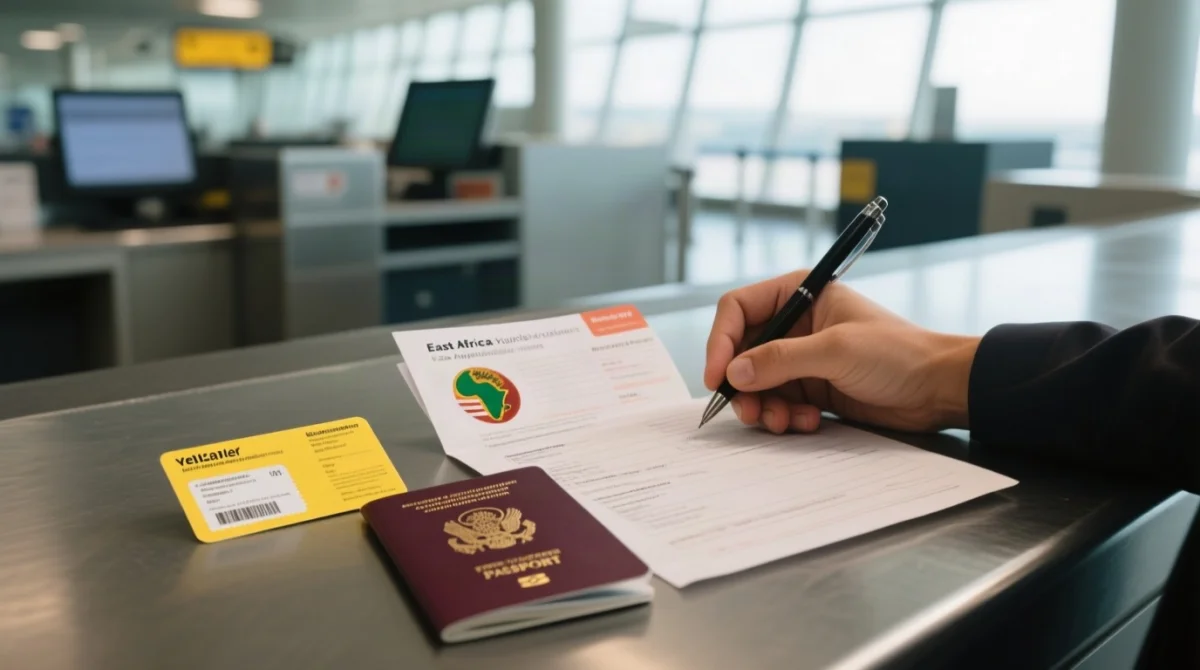
Under IHR 2005 Annex 7, the certificate is mandatory if you arrive from a WHO-listed risk country. Uganda requires it for all arrivals aged 9 months+; Kenya and Rwanda only if travel history triggers the rule (age 1 year+). Yellow fever is a mosquito-borne viral disease and the only disease for which proof of vaccination may be required as a condition of entry under IHR 2005. See the WHO country list (2020) and NaTHNaC Kenya advice.
Country-by-Country Rules
| Country | Mandatory for all? | Trigger condition | Where checked |
|---|---|---|---|
| Uganda | Yes – all arrivals | Regardless of origin; 9 months+ | Entebbe immigration desk |
| Kenya | No | Arrival from or transit ≥12 h through WHO risk country; 1 year+ | Nairobi (JKIA) immigration |
| Rwanda | No | Arrival from endemic country; 1 year+ | Kigali immigration + temperature screening |
The 12-Hour Transit Rule Explained
A layover ≥12 hours in a WHO risk country triggers the yellow fever certificate East Africa requirement; <12 hours does not. Uganda waives no exemption. The WHO 2010 expert assessment established this threshold; risk below 12 hours is almost non-existent.
| Airport | City | Endemic? | Certificate required? |
|---|---|---|---|
| ADD (Bole) | Addis Ababa | Yes | Yes if layover ≥12 h |
| JKIA | Nairobi | Yes | Yes if layover ≥12 h |
| DXB | Dubai | No | Never |
| DOH | Doha | No | Never |
Your Travel History Decision Tree: Step-by-Step Guide
Three factors determine the requirement: departure point, transit duration (≥12 h in WHO risk country), and destination rules. Officers assess these against the IHR 2005 Annex 7 threshold.
UK → Nairobi, direct flight: NO
UK is not on the WHO risk list; no transit through an endemic country.
UK → Addis Ababa (14 h) → Nairobi: YES
Layover ≥12 h in a WHO-listed risk country triggers the yellow fever certificate East Africa requirement.
UK → Addis Ababa (8 h) → Nairobi: NO
Transit <12 h in a risk country does not trigger the requirement.
Overland Uganda → Kenya: YES
Uganda is a WHO-listed risk country; Kenya requires the certificate at Busia or Malaba crossings.
UK → Uganda → Rwanda overland: YES
Uganda mandates the certificate for all arrivals; Rwanda may re-check at Cyanika or Kagitumba border.
Getting and Presenting Your Yellow Fever Certificate in the UK
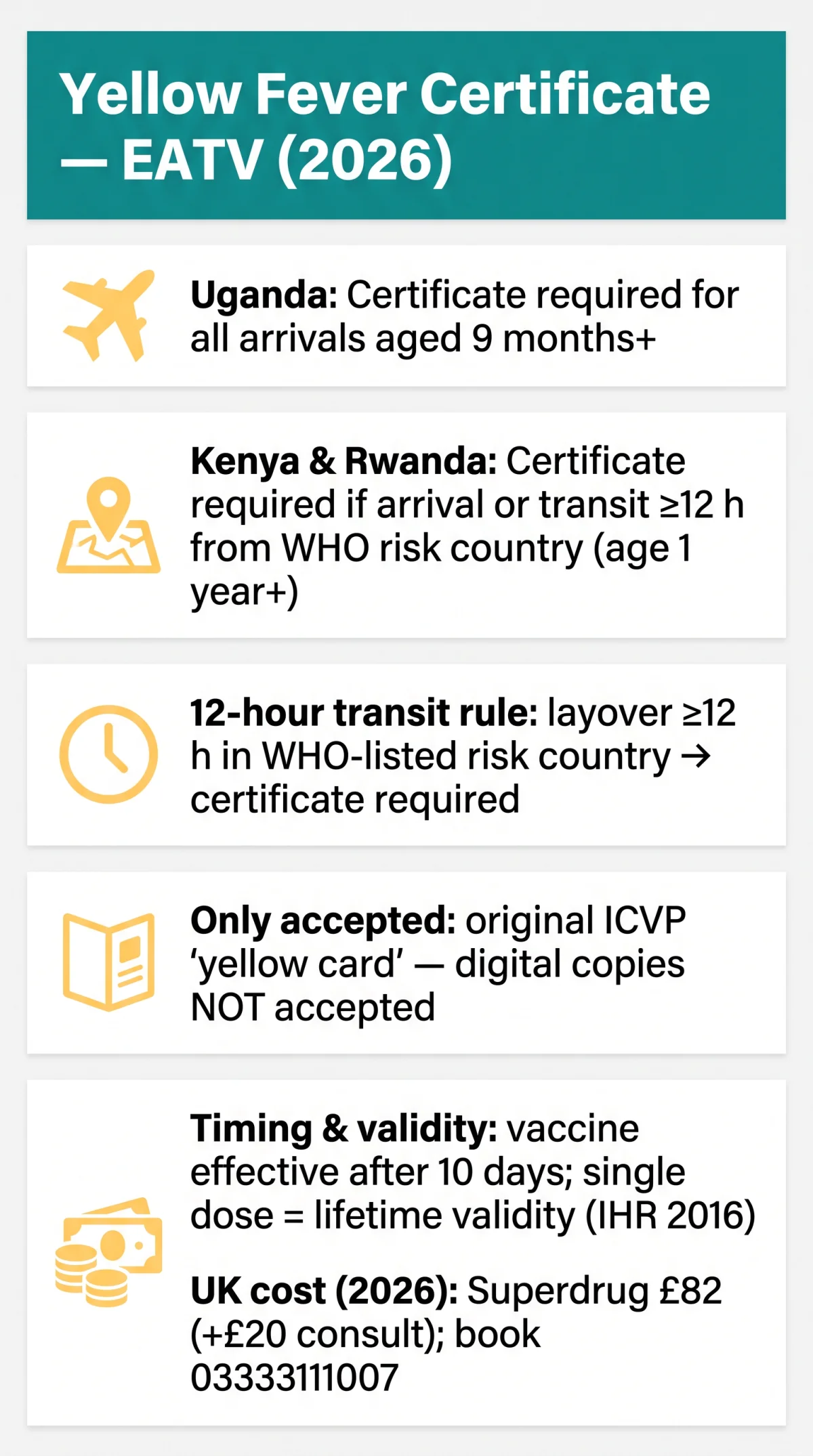
Obtain the original physical ICVP booklet from a UK YFVC and present it at immigration on arrival, not during the online EATV application.
Certificate Validity and Format
Since the IHR 2005 amendment effective 11 July 2016, a single dose provides lifetime validity. No booster is required as a condition of entry. A certificate issued in 2010, 2015, or 2020 remains valid in 2026. The certificate becomes valid 10 days after vaccination; a traveller departing on 1 March 2026 must vaccinate by 19 February 2026. Only the original physical ICVP booklet (Carte Jaune / yellow card) is accepted; NHS App records, PDF scans, and digital images are rejected.
UK Clinic Logistics
Yellow fever vaccination is not available on the NHS. It is administered only at NaTHNaC-designated YFVCs. At Superdrug Health Clinics, the vaccination costs £82 (single dose, certificate issued same day); a £20 consultation fee may apply. Book by phone at 03333111007 or visit Superdrug Health Clinics. Fees confirmed by telephone on 9 September 2026.
Aqua Pharmacy and Travel Clinic, 59 Mill Lane, West Hampstead London NW6 1NB. Tel: 020 7435 4273. Mon-Fri 09:00-19:00, Sat 09:00-13:00. WHO-certified YF centre; walk-ins welcome. Superintendent Pharmacist: Sanjay Patel, GPhC 2045157.Exemptions, Land Borders, and Consequences of Non-Compliance
The yellow fever certificate East Africa requirement exempts children under 1 year under the IHR 2005 baseline, though Uganda enforces a stricter threshold of 9 months at Entebbe. Medically exempt travellers must carry an original doctor’s letter on clinic letterhead, in English or French, referencing the IHR exemption clause. Arriving without valid documentation risks entry denial, quarantine, or deportation.
Age and Medical Exemptions
Exemption grounds: pregnancy, immunosuppression, severe egg allergy, age >60 (clinician discretion). Contraindications include compromised immune systems and severe egg allergy. The letter must include: clinic letterhead, physician name + registration number, patient name + passport number, medical reason, date, and clinic stamp. Some UK clinics advise a booster for children under 2; follow clinic-specific guidance. EATV land-border checkpoints at Busia and Malaba (Kenya-Uganda) and Cyanika (Rwanda-Uganda) may re-check the physical ICVP booklet during overland transfers within the EAC (East African Community) trilateral zone.
What Happens If You Arrive Without It
| Country | Check location | Emergency vaccination | Approx. fee | Deportation risk |
|---|---|---|---|---|
| Uganda | Entebbe airport immigration | Yes | ~$50-100 | Yes if refused |
| Kenya | JKIA immigration, Nairobi | Limited | Varies | Possible |
| Rwanda | Kigali airport + temperature screening | Not at airport | N/A | Possible |
Officers verify authenticity through visual inspection of the WHO emblem, clinic stamp, batch number, and vaccinator signature. No digital verification system exists at East African borders; manual cross-referencing with passport stamps is the only method used.
This article is for general guidance only and does not constitute official immigration or medical advice. Border officers have final discretion. Official sources: WHO Yellow Fever, NaTHNaC TravelHealthPro, Uganda Ministry of Health, Kenya eCitizen, Rwanda Immigration.
FAQ: Yellow Fever Certificate East Africa and the EATV
Do I need a yellow fever certificate for the EATV if flying direct from the UK?
No. The UK is not on the WHO yellow fever risk list, so direct UK flights to Nairobi, Entebbe, or Kigali do not require a yellow fever certificate East Africa. The sole exception is Uganda, which mandates it for all arrivals regardless of origin.
Does the 12-hour transit rule apply to all East African countries?
The 12-hour transit rule applies to Kenya, Rwanda, and Tanzania. A layover ≥12 hours in a WHO-listed risk country triggers the yellow fever certificate East Africa requirement. Uganda does not honour the 12-hour exemption and requires the certificate regardless of transit duration.
Is a digital yellow fever certificate accepted at East African borders?
No. Only the original physical ICVP booklet is legally recognised. Digital images, PDF scans, and NHS App records are rejected. A scanned copy may serve as a personal backup but not as a legal substitute at immigration checkpoints.
How much does a yellow fever certificate cost in the UK in 2026?
The vaccination and certificate cost £82 at Superdrug Health Clinics (single dose, certificate issued same day). A £20 consultation fee may apply. The vaccine is not available on the NHS; obtain it at a designated YFVC. Superdrug booking phone: 03333111007.
How long is the yellow fever certificate valid for?
Since the IHR 2005 amendment effective 11 July 2016, a single dose provides lifetime validity. No booster is required as a condition of entry. The certificate becomes valid 10 days after vaccination. Certificates issued before 2016 under the previous 10-year rule remain valid for life.
What happens if I arrive in Uganda without a yellow fever certificate?
Entry denial, emergency vaccination at Entebbe (~$50-100), quarantine, or deportation. Uganda requires the yellow fever certificate East Africa for all arrivals aged 9 months+, regardless of travel history.
Do children need a yellow fever certificate for the EATV?
Children under 1 year are exempt under the IHR baseline. Uganda enforces a stricter threshold of 9 months. Children aged 9 months+ (Uganda) or 1 year+ (Kenya, Rwanda) must present a valid certificate if the travel-history trigger applies. Some UK clinics advise a booster for children under 2; follow clinic-specific guidance.
Can I get a medical exemption for the yellow fever vaccine?
Yes. Exemption grounds: pregnancy, immunosuppression, severe egg allergy, age >60 (clinician discretion). Requires an original letter from a registered physician on clinic letterhead, in English or French, referencing the IHR exemption clause. Must include patient name, passport number, medical reason, date, and clinic stamp.