
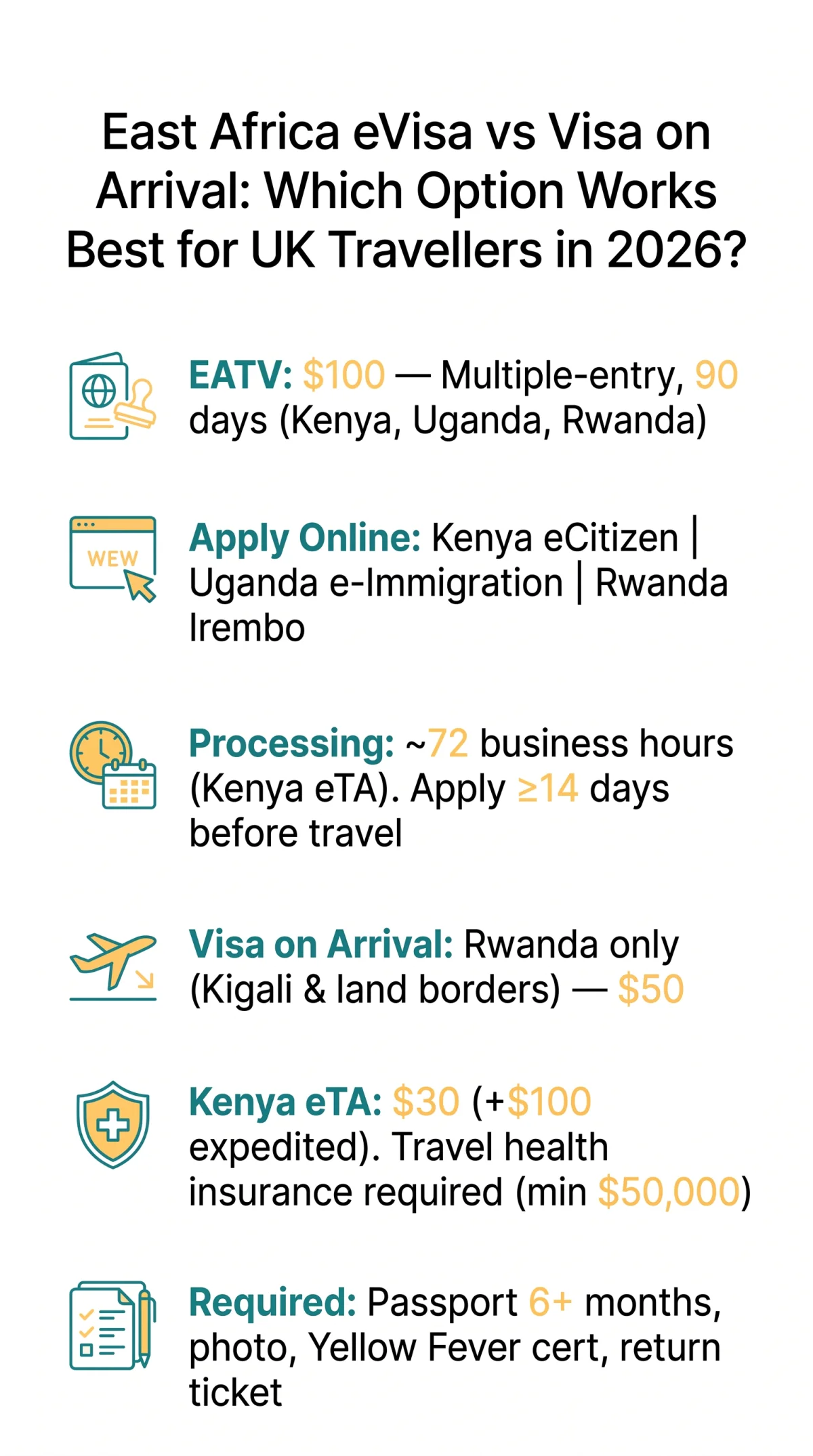
The East Africa eVisa vs visa on arrival comparison is clear: the East Africa Tourist Visa (EATV) costs $100, covers Kenya, Uganda, and Rwanda for 90 days, and eliminates embassy visits. Visa on arrival is available only in Rwanda. The eVisa is processed online through national immigration portals, with the Kenya eTA taking approximately 72 business hours. Traditional embassy visas require physical visits to London, paper submissions, and processing times of 2 to 6 weeks. In 2026, Uganda has discontinued visa on arrival, and Kenya has replaced it with the electronic travel authorisation (eTA) system. Only Rwanda still offers visa on arrival at Kigali International Airport and all land borders. UK travellers should apply online at least 14 days before departure to ensure smooth border control procedures.
Last updated: 9 September 2026. Visa rules change frequently; always confirm with the relevant immigration portal before applying. All fee and visa-on-arrival status information verified September 2026 via the immigration portals of Kenya, Uganda, Rwanda, and Tanzania.
What Is the East Africa Tourist Visa (EATV)?
The East Africa Tourist Visa (EATV) is a $100 multiple-entry eVisa valid for 90 days from date of issuance across Kenya, Uganda, and Rwanda for tourism only. UK passport holders apply online through one of three national portals: Kenya’s eCitizen (etakenya.go.ke), Uganda’s e-Immigration (visas.immigration.go.ug), or Rwanda’s Irembo (irembo.gov.rw). The fee is non-refundable and subject to bank charges.
Log into the portal
Access the chosen national immigration portal.
Select the visa type
Choose the East Africa Tourist Visa option.
Complete the form
Fill in all required application details.
Upload documents
Submit passport, photo, and supporting documents.
Pay the fee
Complete payment via Visa or Mastercard.
Receive the approval letter by email
Confirmation sent electronically after processing.
Report to immigration for biometric capture
Present the approval letter at the border for entry.

The EATV permits multiple entries strictly within the zone (Kenya, Uganda, Rwanda); leaving the block invalidates the visa and a new application is required to re-enter. Employment is prohibited – the visa covers tourism purposes only.
The First-Country Entry Rule
The issuing country must be the traveller’s first entry point. If you apply through Uganda’s e-Immigration portal, you must enter through Uganda before proceeding to Kenya or Rwanda.
eVisa vs Embassy Visa vs Visa on Arrival Comparison
| Channel | Cost | Processing Time | In-Person Visit | Validity | Countries | Rejection Risk |
|---|---|---|---|---|---|---|
| East Africa Tourist Visa (eVisa) | $100 | ~72 hours (Kenya eTA) | No | 90 days | Kenya, Uganda, Rwanda | Low |
| Traditional Embassy Visa | $150-$300 combined | 2-6 weeks | Yes | Varies | Per country | Medium |
| Visa on Arrival | $50 (Rwanda tourist) | ~20 min (Kigali Airport) | Yes (at border) | 30-90 days | Rwanda only | High (unavailable in UG/KE) |
Processing Time and Airport Queues
The East Africa eVisa eliminates airport queue times by delivering pre-approved electronic entry before departure. Kenya’s eTA processes in approximately 72 business hours, with an expedited option available for an additional $100 on top of the $30 standard fee. Tanzania has tightened its visa on arrival policy; advance online application is mandatory for all nationalities via visa.immigration.go.tz.
Visa on Arrival in 2026 – Country-by-Country Status
In 2026, only Rwanda offers visa on arrival to all nationalities; Uganda requires advance eVisa, Kenya replaced VoA with eTA, and Tanzania tightened border rules. The East Africa Tourist Visa (EATV) covers Kenya, Uganda, and Rwanda.
Kenya eTA and New 2026 Health Insurance
Kenya replaced visa on arrival with the Electronic Travel Authorisation (eTA) via etakenya.go.ke at US $30 per person, valid 90 days. From August 2026, Kenya mandates travel health insurance with minimum US $50,000 cover for visitors staying under 12 months. UK travellers with an East Africa Tourist Visa (EATV) entering Kenya must comply; Kenya treats the insurance independently of visa type.
Uganda and Rwanda Status
- Uganda: Visa on arrival discontinued. Apply online at visas.immigration.go.ug; ordinary single-entry visa US $50. NCIC contact: Plot 65/67, Old Port Bell Road, Kampala, Uganda. Phone: +256 417 102 600.
- Rwanda: VoA available at Kigali International Airport and all land borders since 1 January 2018; tourist visa US $50, free for Commonwealth citizens (30-day stay). The EATV is also obtainable via Irembo in advance. DGIE contact: [email protected], +250-788-152-222.
Tanzania Tightened Rules
Tanzania is not part of the East Africa Tourist Visa (EATV) scheme. Ordinary single-entry visa costs US $50; multiple-entry US $100. Visa on arrival policy has tightened; advance online application is mandatory for all nationalities via visa.immigration.go.tz. Referred visa required for certain nationalities – must be approved before travel. Zanzibar mandates travel insurance for all arriving travellers except Tanzania residents, effective 1 October 2024 (apply at visitzanzibar.go.tz).
Why Travellers Prefer the eVisa Over the Traditional Embassy Route
- Eliminates in-person embassy visits
- Accepts documents electronically
- Delivers approval letters by email
- Saves 2 to 6 weeks compared to traditional embassy visas
- Family of four saves $200-$800 vs separate embassy visas
- All fees are non-refundable
- Mandatory bank charges of $4-$8
- Revolut/Wise may fail on Uganda’s portal
- Generally not renewable or extendable
The Three Application Portals Compared
- Kenya eCitizen (etakenya.go.ke): most mature portal; accepts Visa/Mastercard; customer care: +254 202 222 022, [email protected]
- Rwanda Irembo (irembo.gov.rw): minimalist interface; accepts Revolut/Wise cards
- Uganda e-Immigration (visas.immigration.go.ug): less intuitive; may reject some debit cards; NCIC phone: +256 417 102 600
Tip: Revolut and Wise work on Irembo but may fail on Uganda’s portal – carry a backup Visa debit card.
Requirements, Full Cost Breakdown, and Hidden Fees
EATV requirements: passport with 6 months validity and 1 blank page, recent passport photo, Yellow Fever Vaccination Certificate, return ticket, and travel itinerary. The standard EATV fee is US $100 (real total $104-$108 after bank charges). Kenya eTA costs $30 (optional $100 expedited). All fees are non-refundable.
Hidden Fees and Non-Refundable Policy
EATV carries mandatory bank charges of $4-$8. Visa/Mastercard accepted on all portals; Amex not widely accepted; Revolut/Wise may fail on Uganda’s portal. At Kigali Airport VoA counter, card is preferred, exact USD cash recommended.
Kenya’s New Mandatory Travel Health Insurance (From August 2026)
From August 2026, Kenya requires visitors staying under 12 months to hold travel health insurance (minimum US $50,000). This requirement is expected to be integrated into the eTA application process. Existing travel insurance policies are accepted if they meet the $50,000 minimum threshold.
Overstay Penalties, Grace Periods, and Extension Rules
Daily fines apply for overstays in Uganda and Kenya. Rwanda offers a 5-day grace period after visa expiry before penalties apply. The East Africa Tourist Visa (EATV) is generally not renewable or extendable; Rwanda may process extensions at DGIE offices while the visa remains valid.
Frequently Asked Questions: East Africa eVisa vs Visa on Arrival
How long is the East Africa Tourist Visa valid?
The East Africa Tourist Visa (EATV) is valid for 90 days from date of issuance, allowing multiple entry within Kenya, Uganda, and Rwanda for tourism only.
Can I get a visa on arrival in Uganda in 2026?
No. Uganda discontinued visa on arrival. Apply online through the Uganda e-Immigration portal before travel; ordinary single-entry visa costs $50.
How much does the East Africa eVisa cost for UK citizens in 2026?
The East Africa Tourist Visa costs US $100 per person, plus bank charges ($4-$8), totalling approximately $104-$108. All fees are non-refundable.
Do children need a separate eVisa for East Africa?
Each traveller, including infants, requires an independent application and the full $100 EATV fee. Verify with the relevant immigration portal before applying.
What payment methods are accepted on the East Africa eVisa portals?
Visa and Mastercard are accepted on all three portals (eCitizen, Irembo, Uganda e-Immigration). Amex is not widely accepted. Revolut/Wise work on Irembo but may fail on Uganda’s portal.
How long does it take to get an East Africa eVisa approved?
Kenya eTA processes in approximately 72 business hours; expedited option available for additional $100. Apply at least 14 days before departure.
What happens if I overstay my East Africa Tourist Visa?
Daily fines apply in Uganda and Kenya. Rwanda offers a 5-day grace period after expiry before penalties apply. The EATV is generally not renewable or extendable.
Do I need a yellow fever certificate for the East Africa eVisa?
Yes. A valid Yellow Fever Vaccination Certificate is required for entry to Uganda, Kenya, and Rwanda. Carry the original certificate with your passport.
Can I extend my East Africa eVisa once in the country?
In Rwanda, extensions may be processed at DGIE offices while the visa remains valid, with a 5-day grace period after expiry. Uganda and Kenya do not allow EATV extensions.
What happens if I lose my passport with the eVisa sticker between borders?
Report the loss to local police and visit the nearest immigration office of the issuing country for a replacement visa. Carry digital copies of your approval letter and passport bio-data page.